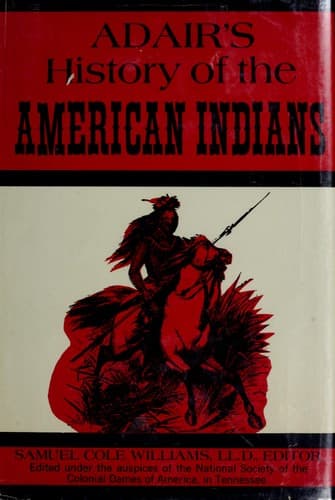
Adair's History of the American IndiansAdair, James
History
Adair's History of the American Indians
Adair, James
Indians -- Origin; Indians of North America -- Southern States
From the historical descriptions of the Alps, and a personal view of the
Cheerake mountains—I conclude the Alps of Italy are much inferior to
several of the Cheerake mountains, both in height and rockiness: the
last are also of a prodigious extent, and frequently impassable by an
enemy. The _Allegeny_, or “great blue ridge,” commonly called the
_Apalahche_-mountains, are here above a hundred miles broad; and by the
best accounts we can get from the Missisippi Indians, run along between
Peru and Mexico, unless where the large rivers occasion a break. They
stretch also all the way from the west of the northern great lakes, near
Hudson’s Bay, and across the Missisippi, about 250 leagues above
New-Orleans. In the lower and middle parts of this mountainous ragged
country, the Indians have a convenient passable path, by the foot of the
mountains: but farther in, they are of such a prodigious height, that
they are forced to wind from north to south, along the rivers and large
creeks, to get a safe passage: and the paths are so steep in many
places, that the horses often pitch, and rear an end, to scramble up.
Several of the mountains are some miles from bottom to top, according to
the ascent of the paths: and there are other mountains I have seen from
these, when out with the Indians in clear weather, that the eye can but
faintly discern, which therefore must be at a surprising distance.
Where the land is capable of cultivation, it would produce any thing
suitable to the climate. Hemp, and wine-grapes grow there to admiration:
{228} they have plenty of the former, and a variety of the latter that
grow spontaneously. If these were properly cultivated, there must be a
good return. I have gathered good hops in the woods opposite to Nuquose,
where our troops were repelled by the Cheerake, in the year 1760. There
is not a more healthful region under the sun, than this country; for the
air is commonly open and clear, and plenty of wholesome and pleasant
water. I know several bold rivers, that fill themselves in running about
thirty miles, counting by a direct course from their several different
fountains, and which are almost as transparent as glass. The natives
live commonly to a great age; which is not to be wondered at, when we
consider the high situation of their country,—the exercise they
pursue,—the richness of the soil that produces plenty for a needful
support of life, without fatiguing, or over-heating the planters,—the
advantages they receive from such excellent good water, as gushes out of
every hill; and the great additional help by a plain abstemious life,
commonly eating and drinking, only according to the solicitations of
nature. I have seen strangers however, full of admiration at beholding
so few old people in that country; and they have concluded from thence,
and reported in the English settlements, that it was a sickly
short-lived region: but we should consider, they are always involved in
Public-domain text, read in full here on John Shaqi.
Reviews
Reviews
No reviews yet
Be the first to share your thoughts on this work.
Elsewhere in the archive
Join the Discussion
Join the discussion
Sign in to leave a comment or review.
Sign InorCreate an account