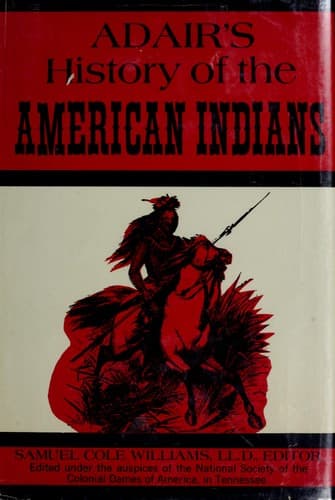
Adair's History of the American IndiansAdair, James
History
Adair's History of the American Indians
Adair, James
Indians -- Origin; Indians of North America -- Southern States
Like the Hebrews, they seldom, if ever, double the liquid consonant _R_;
for they generally seem desirous of shuffling over it, at any rate: And
they often give it the sound of _L_; but, if it precedes a word, where
the other consonant soon follows, they always give it its proper sound,
contrary to the usage of the Chinese: as the name of a stone, they often
call, _Tahle_, instead of _Tahrè_; but the Indians say, _“Tahre
lakkana”_, literally, “Yellow stone,” _i. e._ gold.
The Hebrews subjoined one of their serviles, to words, to express the
pronoun relative, _thy_ or _thine_: And as that particle was also a note
of resemblance, it shews the great sterility of that language. As a
specimen—They said אביך, (Abiche) “your father,” and אמך, (Ameche) “Your
mother,” &c. Only that the Hebrew period is initial, in such a case, to
the Indian nouns, they always use the very same method of expression.
This I shall illustrate with two words in the dialects of the Chikkasah
and Cheerake—as _Chinge_ and _Chatokta_, “your father;” _Angge_ and
_Aketohta_ signifying “my father,” in resemblance of אב, _Abba_, of the
same import; likewise _Chishka_ and _Chacheeah_, “your mother;” for
_Saske_ and _Akachee_ signify “my mother,” in imitation of אשה, _Ashe_.
Also _Sas Kish_ signifies podex meus, _Chish Kish_, podex tuus, and
_Kish Kish_, podex illius; which I guess to be an {40} opprobrious
allusion to Kish the father of Saul, for the son’s assuming the throne
at the end of the Jewish theocracy. In their adjectives and verbs, they
use the same method of speech; as _Nahoorèso Chin-Chookoma_, “Your book
is good.” The former word is compounded of נא (_Na_) now, or the present
time, and _Hoorèso_, delineated, marked, or painted. _Aia_ signifies _to
go_, and _Maia-Cha_, “Go along,” or _Maia_, the same; for, by prefixing
מ to it, it implies a requisite obedience. In like manner, _Apeesah_, to
see, and _Peesàcha_, look, or “see you.” And, when that particle is
prefixed to a verb, it always expresses the accusative case of the same
pronoun; as _Chepeesahre_, “I saw you,” and _Chepeesahras_, “I shall see
you.” Each of the Hebrew characters are radicals; although half of them
are _serviles_, according to that proper term of the scholiasts; for,
when they are prefixed, inserted, or subjoined, either at the beginning,
middle, or end of a radical word, _they serve_ to form its various
augments, inflexions, and derivatives. According to this difficult
standard of speech, the Indian nouns, moods, and tenses, are variously
formed to express different things. As there is no other known language
or dialect, which has the same tedious, narrow, and difficult
principles; must we not consider them to be twin-born sisters? The want
of proper skill to observe the original fixed idea of the Indian words,
their radical letters, and the due sounds in each of them, seems to have
been the only reason why the writers on the American Aborigines, have
Public-domain text, read in full here on John Shaqi.
Reviews
Reviews
No reviews yet
Be the first to share your thoughts on this work.
Elsewhere in the archive
Join the Discussion
Join the discussion
Sign in to leave a comment or review.
Sign InorCreate an account