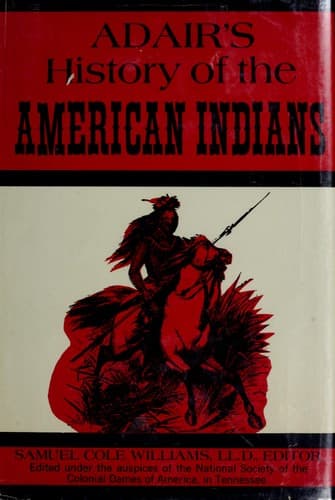
Adair's History of the American IndiansAdair, James
History
Adair's History of the American Indians
Adair, James
Indians -- Origin; Indians of North America -- Southern States
not exhibited the true and genuine properties of any one of their
dialects; as they are all uniform in principle: so far at least, as an
extensive acquaintance reaches.
The Hebrew nouns are either derived from verbs, or both of them are one
and the same; as ברכה, (Beroche) “Blessing,” from ברך, (Beroch) “to
bless,” and דבר חבר, (Dabar Daber) “he spoke the speech.” This proper
name signifies “loquacious,” like the Indian _Sekàkee_, signifying the
“grasshopper.” The Indian method of expression, exactly agrees with that
Hebrew mode of speech; for they say _Anumbole Anumbole (kis)_ “I spake
the speaking;” and _Anumbole Enumbole (kis)_, “he spoke the speaking, or
speech.” And by inserting the name of God between these two words, their
meaning is the very same with those two first Hebrew words. I shall
subjoin another word of the same sort—_Hookseeleta_ signifies “a
shutting instrument;” and they say _Ishtookseelèta_, or _Hookseelèta,
Ish-hookseetas_, or _Hookseetà Cha_, “You shall, or, shut you the door.”
Their period of the last word, always denotes the second person singular
of the imperative mood; {41} and that of the other preceding it, either
the first or second person singular of the indicative mood; which is
formed so by a fixed rule, on account of the variegating power of the
serviles, by affixing, inserting, or suffixing them, to any root.
According to the usage of the Hebrews, they always place the accusative
case also before the verb; as in the former Indian words.
With the Hebrews, תפלח signified “a prayer,” or a religious invocation,
derived from פלח, Phelac, “to pray to, or invoke the Deity.” In a strong
resemblance thereof, when the Indians are performing their sacred dance,
with the eagles tails, and with great earnestness invoking _Yo He Wah_
to bless them with success and prosperity, _Phale_ signifies, “waving,”
or invoking by waving, _Ishphāle_, you wave, _Phalècha_, wave you,
_Aphalàle_, I waved, _Aphalèlas_, I will wave, &c. Psalmodists seem to
have borrowed the notes _fa_, _la_, from the aforesaid Hebrew words of
praying, singing to, or invoking Elohim. פעל, (Phoole) “to work,” is
evidently drawn from the former Hebrew word, which signifies to invoke
(and probably to wave the feathers of the cherubic eagle before) _Yo He
Wah_. The greatest part of the Levitical method of worshipping,
consisted in laborious mechanical exercises, much after the Indian
manner; which the popish priests copy after, in a great many instances,
as pulling off their clothes, and putting on others; imagining that the
Deity is better pleased with persons who variegate their external
appearances, like Proteus, than with those who worship with a steady,
sincere disposition of mind; besides a prodigious group of other
superstitious ceremonies, which are often shamefully blended with those
of the old pagans.
Public-domain text, read in full here on John Shaqi.
Reviews
Reviews
No reviews yet
Be the first to share your thoughts on this work.
Elsewhere in the archive
Join the Discussion
Join the discussion
Sign in to leave a comment or review.
Sign InorCreate an account