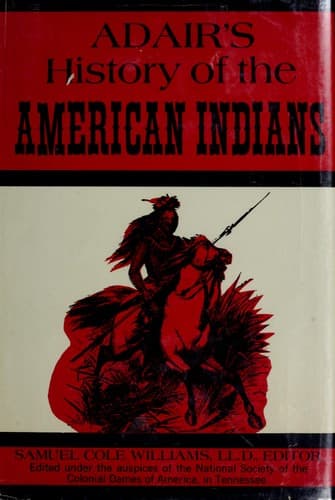
Adair's History of the American IndiansAdair, James
History
Adair's History of the American Indians
Adair, James
Indians -- Origin; Indians of North America -- Southern States
The Cheerake method of adjuring a witness to declare the truth, strongly
corroborates the former hints, and will serve as a key to open the
vowels of the great, mysterious, four-lettered name of God. On small
affairs, the judge, who is an elderly chieftain, asks the witness,
_Cheeakõhgà (sko?)_ “Do you lie?” To which he answers, _Ansa
Kai-e-koh-gà_, “I do not lie.” But {48} when the judge will search into
something of material consequence, and adjures the witness to speak the
naked truth, concerning the point in question, he says “O E A (_sko_?)”
“What you have now said, is it true, by this strong emblem of the
beloved name of the great self-existent God?” To which the witness
replies, O E A, “It is true, by this strong pointing symbol of YO HE
WAH.” When the true knowledge of the affair in dispute, seems to be of
very great importance, the judge swears the witness thus: O E A—YAH
(_sko_?) This most sacred adjuration imports, “Have you now told me the
real truth by the lively type of the great awful name of God, which
describes his necessary existence, without beginning or end; and by his
self-existent literal name, in which I adjure you.” The witness answers,
O E A—YAH, “I have told you the naked truth, which I most solemnly
swear, by this strong religious picture of the adorable, great, divine,
self-existent name, which we are not to prophane; and I likewise attest
it, by his other beloved, unspeakable, sacred, essential name.”
When we consider that the period of the adjurations, according to their
idiom, only asks a question; and that the religious waiters say YAH,
with a profound reverence, in a bowing posture of body, immediately
before they invoke YO HE WAH,—the one reflects so much light upon the
other, as to convince me, that the Hebrews, both invoked and pronounced
the divine tetragrammaton, YO HE WAH, and adjured their witnesses to
give true evidence, on certain occasions, according to the Indian usage;
otherwise, how could they possibly, in a savage state, have a custom of
so nice and strong-pointing a standard of religious caution? It seems
exactly to coincide with the conduct of the Hebrew witnesses even now on
the like religious occasions—who being sworn, by the name of the great
living God, openly to declare the naked truth, hold up their right hand,
and answer, אמנ אמנ _Amen Amen_, or “very true;” “I am a most faithful
witness.” The Hebrew word signifies faithful, and by being repeated
twice, becomes a superlative, and O E A—YAH is one of the highest
degree.
St. John, in his gospel, according to the Hebrew method of adjuration,
often doubles the _Amen_. And the same divine writer, at the beginning
of each of his seven epistles, in describing the glorious and
transcendant qualities of Jesus Christ, and particularly in the epistle
to the church of Laodicea, points at the same custom, “These things
saith the _Amen_, the faithful and true witness, the beginning of the
creation of God.” {49}
Public-domain text, read in full here on John Shaqi.
Reviews
Reviews
No reviews yet
Be the first to share your thoughts on this work.
Elsewhere in the archive
Join the Discussion
Join the discussion
Sign in to leave a comment or review.
Sign InorCreate an account