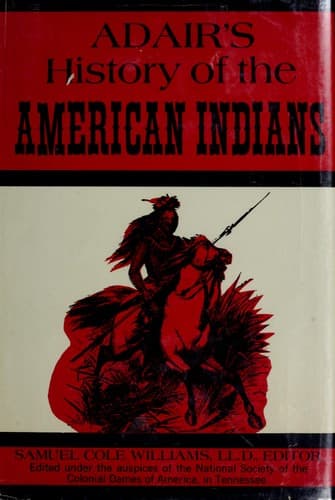
Adair's History of the American IndiansAdair, James
History
Adair's History of the American Indians
Adair, James
Indians -- Origin; Indians of North America -- Southern States
The Cheerake use another expression, which bears a strong analogy to the
former method of adjuration; though it is not so sacred in their
opinion, because of one letter prefixed, and another subjoined. The
judge, in small controversies, asks the witness, _To e u (sko?)_ To
which he answers, _To e u_, or _To e u hah_, “It is very true,” or “a
most certain truth.” Such an addition of any letter, or letters, to the
vowels of the supposed divine, four-lettered name, seems to proceed from
a strict religious custom of proportioning them to the circumstances of
persons and things, lest, otherwise, they should blaspheme, or prophane
the emblems of the great divine name. And the vowel _U_ seems to allude
to אחד, _i. e._ ONE—a name of God, figuratively—for, in their dialect,
when it is a period, it makes a superlative, according to their usage in
applying the rest of the divine appellatives, symbols, or names.
They esteem _To e u hah_ so strong an assent to any thing spoken, that
_Cheesto Kaiēhre_, “the old rabbet,” (the name of the interpreter) who
formerly accompanied seven of their head warriors to London,[24] assured
me, they held there a very hot debate, in their subterranean lodgings,
in the dead hours of the night of September the 7th, 1730, whether they
should not kill him, and one of the war-chieftains, because, by his
mouth, the other answered _To e u hah_ to his Majesty’s speech, wherein
he claimed, not only their land, but all the other unconquered countries
of the neighbouring nations, as his right and property. When they
returned home, they were tried again, by the national sanhedrim, for
having betrayed the public faith, and sold their country, for
acknowledged value, by firm compact, as representatives of their
country; they having received a certain quantity of goods, and a
decoying belt of white wampum: but, upon serious deliberation, they were
honourably acquitted, because it was judged, the interpreter was bound,
by the like oath, to explain their speeches; and that surprise,
inadvertence, self-love, and the unusual glittering show of the
courtiers, extorted the sacred assent, _To e u hah_, out of the other’s
mouth, which spoiled the force of it; being much afraid, lest they
should say something amiss, on account of the different idiom of the
English, and Indian American dialects[XII]. As there is no alternative
between a falsehood, and a lie, they {50} usually tell any person, in
plain language, “You lie,” as a friendly negative to his reputed
untruth. The cheerful, inoffensive _old rabbet_ told me, he had urged to
them, with a great deal of earnestness, that it was certain death by our
laws, to give his Majesty the lie to his face; and cautioned them to
guard their mouths very strongly from uttering such dangerous language:
otherwise, their hearts would become very heavy, and even sorrowful to
death; as he would be bound as firmly by our holy books, to relate the
bare naked truth, as they were by repeating _To e u ah_, or even
Public-domain text, read in full here on John Shaqi.
Reviews
Reviews
No reviews yet
Be the first to share your thoughts on this work.
Elsewhere in the archive
Join the Discussion
Join the discussion
Sign in to leave a comment or review.
Sign InorCreate an account