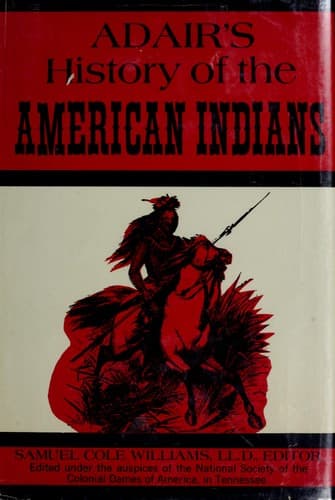
Adair's History of the American IndiansAdair, James
History
Adair's History of the American Indians
Adair, James
Indians -- Origin; Indians of North America -- Southern States
Although the Hebrews had a proper name for the human soul, calling it
נפש; yet in _Prov._ xx. 27, it is called נר יהוה, “The candle, or lamp
of God;” and figuratively applied, it conveys a strong idea of the human
soul: Thus the Indians term it, _Nāna Ishtohoollo_, “something of, or a
relation to, the great holy One;” very analogous to the former method of
expressing the rational Fire, as they believe the Deity resides in the
new year’s, supposed principle, in allusion to the celestial cherubic
name אש, _Ashe_, holy fire. Because _Ish_, Man, received his breath from
the divine inspiration of the beneficent creator YAH, they term the
human {54} species, in their strong-pointing language, _Yāhwè_; which,
though different from the divine, essential, four-lettered name, in
sound has יה, YAH, for its radix. But, because the monkey mimics
_Yahweh_, or the rational creation, more than any other brute, in
features, shape, gesture, and actions; in proportion to the similitude,
they give him a similar name, _Shaw-we_. This indeed makes a near
approach to _Ish_ and _Yah_, and to _Yahwe_; but it wants the radix of
both, and consequently bears no signification of relation to either.
While they urge, that the regularity of the actions of the brute
creatures around them, expresses a nice understanding or instinct; they
deny their being endued with any portion of the reasoning, and living
principle, but bear only a faint allusion to _Nana Ishtohoollo_, the
rational soul. The most intelligent among them, say the human soul was
not made of clay, like the brute creation, whose soul is only a
corporeal substance, attenuated by heat, and thus rendered invisible.
Through a seeming war-contempt of each other, they all use a favourite
termination to their adjectives, (very rarely to their substantives) and
sometimes to their verbs; especially when they are flourishing away, in
their rapid war-speeches, which on such occasions they always repeat
with great vehemence. I shall give a specimen of two words, in the
dialects of our southern Indians. _RI_ is the favourite period of the
Katāhba Indians; as _Mare-ŕi_, or _Wahre-ŕi_, “Good,” and
_Maretawah-ŕi_, or _Wah-rètawàh-ŕi_, “best,” or very good; _Wah_, the
last syllable of the great divine name, is evidently the radix, and
magnifies the virtuous idea to a superlative. In like manner,
_Shegàre-Wahŕi_, “not bad,” but _Sheekàre-ŕi_, signifies “bad.” With
these Indians, _Sheeke_ is the name of a buzzard, which they reckon to
be a most impure fowl, as it lives on putrid carcasses; upon which
account, they choose that word to convey a vicious idea.
Public-domain text, read in full here on John Shaqi.
Reviews
Reviews
No reviews yet
Be the first to share your thoughts on this work.
Elsewhere in the archive
Join the Discussion
Join the discussion
Sign in to leave a comment or review.
Sign InorCreate an account