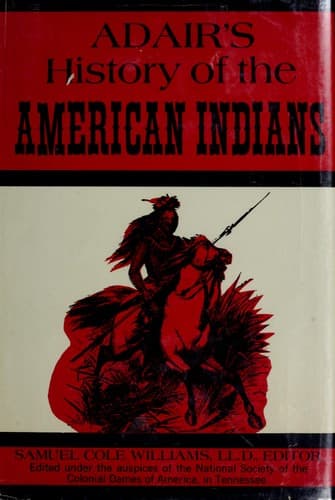
Adair's History of the American IndiansAdair, James
History
Adair's History of the American Indians
Adair, James
Indians -- Origin; Indians of North America -- Southern States
_Quo_ is the sounding termination of the Cheerake; as _Seohsta-quo_,
“good,”—and _O-se-u_, “best,” or very good. Here they seem to have
studiously chosen the vowels:—As the following words will illustrate,
_Tonnàte-ū_, “very honest,” or virtuous, and _Y-O-U_, “Evil,” or very
bad. To corroborate the hints I gave, concerning the Indian names of
monkey, and the human species, let it be observed, that though their
words convey a virtuous or vicious idea, in proportion as they are
constituted out of {55} any of their three divine names, YOHEWAH, YAH,
and ISHTOHOOLLO; or contain the vowels of the great sacred name, yet the
aforesaid word Y-O-U, is so far from being a deviation from that general
custom, it is an emphatical, and emblematical term to express evil, by
the negative of good; for, as it is the only substantive or adjective of
that word, it is a strong expressive symbol of the nature, and physical
cause of moral evil, by separating _YO_, the first syllable of the
divine four-lettered name into two syllables; and adding _U_, as a
superlative period, to make it _malum malorum_.
_Shèh_ is the sounding criterion of the Muskohge, or Creek Indians,—a
kind of cant jargon, for example; _Heettla-sheh_, signifies “good,” and
_Heettla-wah-E-sheh_, “very good;” according to their universal standard
of speech, it becomes a superlative, by subjoining that part of the
divine name to it. With the Chikkasah and Choktah, _Heettla_ signifies
dancing; probably because that religious exercise was good and highly
pleasing to them, when, according to ancient custom, they danced in
their symbolical circles, to, and before, YO HE WAH. With the former,
_Apullowhage sheh_, expresses “bad,” or evil, thereby inverting the
divine letters.
_Skeh_ is the favourite termination of the Chikkasah and Choktah—as
_Chookòma-skeh_, “good,” _Chookòmasto-skeh_ (alluding to _Ishto_) “very
good;” and _Ookproo-skeh_, “bad.” Likewise, _Ookproosto_, “worst,” or
very bad; for, by annexing the contracted initial part of the divine
name, _Ishtohoollo_, to the end of it, it is a superlative. These
remarks may be of service to the inhabitants of our valuable and
extensive barriers, in order to discover the national name of those
savages, who now and then cut them off.
_Ookproo-see_, with those Indians, signifies “accursed;” the two last
letters make only a _samech_, which implies a neuter passive: and, as
_Ookproo_ is the only substantive or adjective they use to express
“evil,” by doubling the leading vowel of the four-lettered divine name,
both at the beginning and end of the word; may we not conjecture at its
origin, as glancing at the introduction of sin or evil by man’s
overacting, or innovating, through a too curious knowledge, or choice?
“Ye shall be as gods,” and, in order to gain the resemblance, they ate
what was forbidden. {56}
Public-domain text, read in full here on John Shaqi.
Reviews
Reviews
No reviews yet
Be the first to share your thoughts on this work.
Elsewhere in the archive
Join the Discussion
Join the discussion
Sign in to leave a comment or review.
Sign InorCreate an account