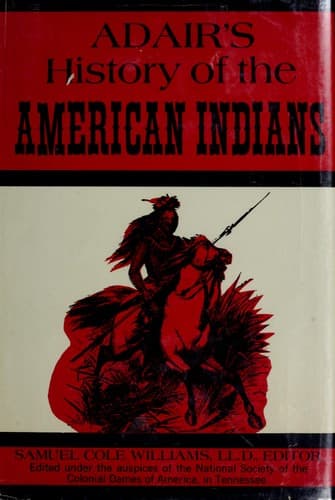
Adair's History of the American IndiansAdair, James
History
Adair's History of the American Indians
Adair, James
Indians -- Origin; Indians of North America -- Southern States
After what hath been said of their language, it may be proper here to
shew how they accent the consonants: I shall range them in the order of
our alphabet, except those they pronounce after our manner. When _CH_
begins a word, or is prefixed to a vowel, it conveys a soft sound, as
_Cháa_, “high;” but otherwise it is guttural: as is _D_, which is
expressed by fixing the tip of the tongue between the teeth, as _Dawi_,
for David. _G_ is always guttural, as we accent _Go_. They cannot
pronounce _Gn_; and they have not the _Hh_, neither can it be expressed
in their dialects, as their leading vowels bear the force of guttural
consonants. They have not the JOD, as I can any way recollect, or get
information of; nor can they repeat it, any nearer than _Chot_. They
pronounce _K_, as in _Ko_; _L_ and _N_, as _D_—_S_, by fixing the tongue
to the lower teeth; _T_ like _D_, as in the old Hibernian, or Celtic
affirmative, _Ta_. They cannot pronounce _V_, or _X_; they call the
governor of Moveel, (Mobille) _Goweno-Moweeleh_: and they have not a
word which begins or ends with _X_. _KS_ are always divided into two
syllables; as _Hak-se_, “mad,” &c. They have not the letter _Z_; much
less any such harsh sound as _Tz_, although they have _Tl_. As they use
the Hebrew consonants _Y_ and _W_, in their most solemn invocation YO HE
WAH, instead of the present Hebrew _Jod_ and _Vau_; so they seem to
exclude them intirely out of their various dialects: the pronunciation
therefore of the Hebrew characters, which are supposed to convey the
other sounds, they are unacquainted with; and those which seem to be
transposed, may be clearly ascertained by persons of proper capacity and
leisure, by comparing a sufficient number of Hebrew and Indian words
together. The Indian accents, _Oo_, and _O_, _Qu_, and _Tl_, may, prove
a pretty good key to speculative enquirers.
_Tl_ often occur in their words; as _Tlumba_, “to bleed with a lancet,
to bore, scoop, or make any thing hollow;” and _Heettla_, “to dance.”
And the South-Americans, we are told, had likewise the same sound, as in
that national name, _Tlaskala_: it seems to have been universal over the
extensive continent. And, from a similarity of the Hebrew manners,
religious rites, civil and martial customs, we have a strong presumptive
proof, that they used the aforesaid double vowels, and likewise a single
vowel, as a termination, to give their words a soft accent: and it is
plain to me, that the Hebrew language did not sound so harsh, as it is
now commonly expressed, but like the American dialects it was
interspersed with vowels, {62} and a vowel was commonly subjoined to
each word, for the sake of a soft cadence; as _Abele_, and _Ale_,
instead of אבל, _Abel_, and אל, _Al_ &c.
Public-domain text, read in full here on John Shaqi.
Reviews
Reviews
No reviews yet
Be the first to share your thoughts on this work.
Elsewhere in the archive
Join the Discussion
Join the discussion
Sign in to leave a comment or review.
Sign InorCreate an account