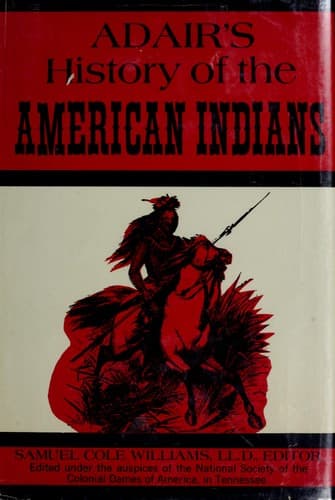
Adair's History of the American IndiansAdair, James
History
Adair's History of the American Indians
Adair, James
Indians -- Origin; Indians of North America -- Southern States
If we consider the proximity of those Indians to a thick-settled
colony, in which there are many gentlemen of eminent learning, it will
appear not a little surprizing that the name _Canaanites_, in the
original language, according to the Indian method of expressing it, as
above, did not excite the attention of the curious, and prompt them to
some enquiry into the language, rites, and customs, of those
Aborigines: which had they effected, would have justly procured them
those eulogia from the learned world, which their society profusely
bestowed on the artful, improved strokes of a former prime magistrate
of South-Carolina, whose conduct in Indian affairs, was so exceedingly
singular, if not sordid and faulty, (as I publicly proved when he
presided there) that another year’s such management would have caused
the Cheerake to remove to the French barrier, or to have invited the
French to settle a garrison, where the late unfortunate Fort-Loudon
stood. But a true British administration succeeding, in the very
critical time, it destroyed their immature, but most dangerous
threatening scheme. This note I insert here, though rather out of
place, to shew, that the northern gentlemen have not made all those
observations and enquiries, with regard to the Indians, which might
have been reasonably expected, from so numerous and learned a body.
The Indians call the lightning and thunder, _Eloha_, and its rumbling
noise, _Rowah_, which may not improperly be deduced from the Hebrew. To
enlighten the Hebrew nation, and impress them with a reverential awe of
divine majesty, God spoke to them at Sinai, and other times during the
theocracy, with an awful or thundering voice. The greater part of the
Hebrews seem to have been formerly as ignorant of philosophy, as are the
savage Americans now. They did not know that thunder proceeded from any
natural cause, but from the immediate voice of Elohim, above the clouds:
and the Indians believe, according to this Hebrew system of philosophy,
that _Minggo Ishto Eloha Alkaiasto_, “the great chieftain of the
thunder, is very cross, or angry when it thunders:” and I have heard
them say, when it rained, thundered, and blew sharp, for a considerable
time, that the beloved, or holy people, were at war above the clouds.
And they believe that the war at such times, is moderate, or hot, in
proportion to the noise and violence of the storm.
Public-domain text, read in full here on John Shaqi.
Reviews
Reviews
No reviews yet
Be the first to share your thoughts on this work.
Elsewhere in the archive
Join the Discussion
Join the discussion
Sign in to leave a comment or review.
Sign InorCreate an account