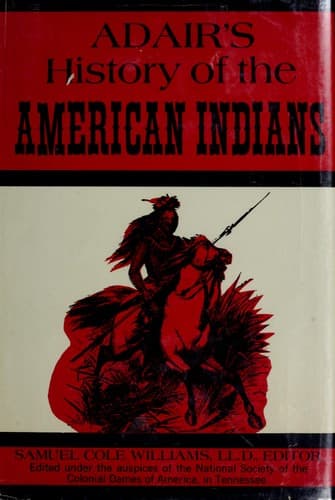
Adair's History of the American IndiansAdair, James
History
Adair's History of the American Indians
Adair, James
Indians -- Origin; Indians of North America -- Southern States
I have seen them in these storms, fire off their guns, pointed toward
the sky; some in contempt of heaven, and others through religion—the
former, to shew that they were warriors, and not afraid to die in any
shape; much less afraid of that threatening troublesome noise: and the
latter, because their hearts directed them to assist _Ishtohoollo
Eloha_[XVI]. May not this {65} proceed from an oral tradition of the war
which the rebellious angels waged against the great Creator; and which
the ancient heathens called the war of the giants? Nothing sounds
bolder, or is more expressive, than the Cheerake name of thunder,
_Eentaquàróske_. It points at the effects and report of the battles,
which they imagine the holy people are fighting above. The small-pox, a
foreign disease, no way connatural to their healthy climate, they call
_Oonatàquára_, imagining it to proceed from the invisible darts of angry
fate, pointed against them, for their young people’s vicious conduct.
When they say, “I shall shoot,” their term is, _Ake-rooka_. The radix of
this word is in the two last syllables; the two first are expressive
only of the first person singular; as _Akeeohoosa_, “I am dead, or
lost;” and _Akeeohooséra_, “I have lost.” _Rooka_ seems to have a
reference to the Hebrew name for the holy Spirit.
Footnote XVI:
The first lunar eclipse I saw, after I lived with the Indians, was
among the Cheerake, An. 1736: and during the continuance of it, their
conduct appeared very surprizing to one who had not seen the like
before; they all ran wild, this way and that way, like lunatics,
firing their guns, whooping and hallooing, beating of kettles, ringing
horse-bells, and making the most horrid noises that human beings
possibly could. This was the effect of their natural philosophy, and
done to assist the suffering moon. And it is an opinion of some of the
East-Indians, that eclipses are occasioned by a great monster
resembling a bull-frog, which now and then gnaws one edge of the sun
and moon, and would totally destroy them, only that they frighten it
away, and by that means preserve them and their light. (A). Mooney
says that the belief that the eclipse monster can be so frightened
away was universal among primitives. (W)
The most southern old town, which the Chikkasah first settled, after the
Chokchoomah,[27], Choktah, and they, separated on our side of the
Missisippi, into three different tribes, they called _Yanèka_, thereby
inverting _Yahkàne_, the name of the earth; as their former brotherhood
was then turned into enmity[XVII]. The bold Creeks on the opposite, or
north side of them, they named _Yahnàbe_, “killing to God,” or devoting
to death; for the mid consonant expresses the present time. And their
proper names of persons, and places, are always expressive of certain
circumstances, or things, drawn from roots, that convey a fixed
determinate meaning.
Footnote XVII:
Public-domain text, read in full here on John Shaqi.
Reviews
Reviews
No reviews yet
Be the first to share your thoughts on this work.
Elsewhere in the archive
Join the Discussion
Join the discussion
Sign in to leave a comment or review.
Sign InorCreate an account