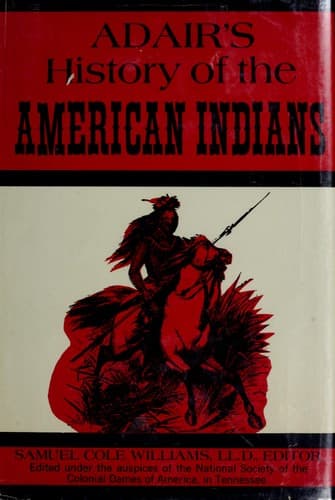
Adair's History of the American IndiansAdair, James
History
Adair's History of the American Indians
Adair, James
Indians -- Origin; Indians of North America -- Southern States
Though they have lost the true meaning of their religious emblems,
except what a very few of us occasionally revive in the retentive
memories of their old inquisitive magi; yet tradition directs them to
apply them properly.{70} They use many plain religious emblems of the
divine names, YOHEWAH, YAH, and ALE,—and these are the roots of a
prodigious number of words, through their various dialects. It is
surprising they were unnoticed, and that no use was made of them, by the
early voluminous Spanish writers, or by our own, for the information of
the learned world, notwithstanding the bright lights they had to direct
them in that æra, when the decorations of their holy temples and
priests, their religious ceremonies, and sacred hymns of praise to the
Deity, of which hereafter, so nearly corresponded with the Israelitish,
and might have been readily discovered by any who eyed them with
attention. In our time, by reason of their long intercourse with
foreigners, we have necessarily but a few dark traces to guide our
inquiries, in the investigation of what must have been formerly, shining
truths.
I must beg to be indulged with a few more remarks on their verbs.[28]—If
we prefix _As_ to _A-a_, “to move,” it becomes _A-sâ-a_, “to offend.”
The monosyllables _Ish_ and _Che_, variously denote the second person
singular; but when the former is by custom prefixed to a verb, the
latter then expresses either the accusative or ablative case singular of
the pronoun relative; as _Ish-a-sâ-ah_, “you are offended, or moved to
say Ah;” _Ish-a-sâ-a-re_, “you were displeased;” but _Che-a-sâ-ah_
signifies “I am displeased with you;” and _Che-a-sâ-a-re_ “I was
offended by you;” _Che-a-sâ-a-chee-le_ is “I occasion, or have
occasioned you to be displeased,” literally, “I produce, or have
produced offence to you;” and _Che-a-sâ-a-cheê-le Awa_, “I shall not
cause you to be displeased.” In like manner, they say _A-ân-ha_, which
signifies “I despise,” or literally, “I move _ha_;” for the mid letter
is inserted for distinction-sake, according to their idiom. So
_A-chîn-ha-chu_, “I shall contemn you;” _A-chîn-ha-cheê-la A-wa_, “I
shall not cause you to become despicable.” _Chee-le_ signifies
literally, “to bring forth young.” So that the former method of
expression is very significant, and yet it shews a sterility of
language, as that single word is applicable to every species of female
animals, fowls not excepted: Thus, _Phoo-she Chee-le_, “the birds lay.”
_Oe-she_ signifies “a young animal,” of any kind—and likewise an egg.
When mentioned alone, by way of excellence, it is the common name of an
infant; but when the name of the species of animals is prefixed to it,
it describes the young creature. _An-push-koosh oo-she_, is what the
tender mother says to her well-pleased infant. The two words import the
same thing. The former resembles the Hebrew, and the latter is likewise
a substantive; they {71} say _Chool-loo-she Teeth-lâ-a-ta-hâh_, “the
Public-domain text, read in full here on John Shaqi.
Reviews
Reviews
No reviews yet
Be the first to share your thoughts on this work.
Elsewhere in the archive
Join the Discussion
Join the discussion
Sign in to leave a comment or review.
Sign InorCreate an account