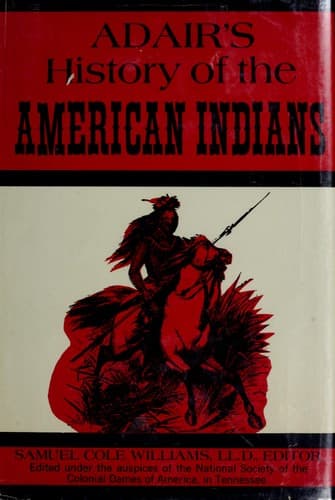
Adair's History of the American IndiansAdair, James
History
Adair's History of the American Indians
Adair, James
Indians -- Origin; Indians of North America -- Southern States
long, as strangers conjecturally draw them out. Instead of a simple
word, we too often insert the wild picture of a double, or
triple-compounded one; and the conjugation of their verbs, utterly
deceives us. A specimen of this, will shew it with sufficient clearness,
and may exhibit some useful hints to the curious searchers of antiquity.
_A-nô-wa_ signifies “a rambler, renegadoe, or a person of no settled
place of abode.” _A-nó-wah_, the first person, and _Ish-na_, the second
person {69} singular, but they have not a particular pronoun for the
third; they distinguish it by custom. _Si-a_, or _Sy-ah_, is “I am;”
_Chee-a_, or _Chy-ah_, “you are;” and _Too-wah_, “he is.” _Ay-ah_
signifies “to go;” _Ay-a-sa_, “I remain;” _Ish-i-a-sa_, “you remain;”
_A-sa_, “he remains.” _A-OO-E-A_ is a strong religious emblem,
signifying “I climb, ascend, or remove to another place of residence.”
It points to _A-nó-wah_, the first person singular, and O-E-A, or YO HE
WAH; and implies, putting themselves under his divine patronage. The
beginning of that most sacred symbol, is, by studious skill, and a
thorough knowledge of the power of letters, placed twice, to prevent
them from applying the sacred name to vain purposes, or created things.
In like manner they say, _Nas-sap-pe-O Ish-OO-E-A_, “You are climbing a
very great acorn-tree,” meaning an oak; for _Nas-se_ is the name of an
acorn; and the mid part of that triple compounded word, is derived from
_Ap-pê-la_, “to help;” _Che-ap-pê-la A-wa_, “I do not help you.” The
termination, according to their mixed idiom, magnifies it to a
superlative. _Quoo-ran-hê-qua_, a noted old camping place, fourteen
miles above the settlement of _Ninety-six_, and eighty-two below the
Cheerake, signifies, in their dialect, “the large white oaks.” _Oos-sak_
is the name of a “hickory-nut,” and _Oos-sak Ap-pe-O_ as above. _Oot-te_
signifies “a chestnut;” _Noot-te_, “a tooth;” _Soot-te_, “a pot;” and
_Oo-te_, “to make a fire,” which may be called an Indian type for eating
boiled chestnuts.
When they say, “He is removing his camp,” they express it in a most
religious manner, _Al-bé-na-OO-E-A_. _Al-be-nâs-le_ signifies “I
camped;” _Al-be-nâs-le-chû_, “I shall, or will, camp:” but, according to
their religious mode of speaking, _Al-bé-na A-OO-E-A-re_, expresses the
former, and _Al-bé-na A-OO-E-A-ri-chû_, the latter phrase; likewise,
_Al-bé-na OO-E-As_ signifies _Castra Moveto_, imperatively. It is worthy
of notice, that as they have no pronoun relative to express the third
person singular, they have recourse to the first syllable of the
essential word, _Toowah_, “He is.” In allusion to that word, they term
the conjunction copulative, _Ta-wah_, and _Tee-U-Wah_, “resting.” So
mixed a train of nice and exact religious terms, could not be invented
by people, as illiterate and savage as the Indians now are, any more
than happen by accident.
Public-domain text, read in full here on John Shaqi.
Reviews
Reviews
No reviews yet
Be the first to share your thoughts on this work.
Elsewhere in the archive
Join the Discussion
Join the discussion
Sign in to leave a comment or review.
Sign InorCreate an account