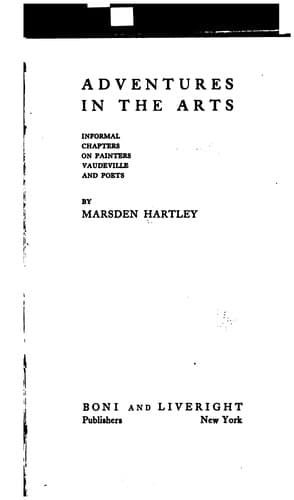
Adventures in the Arts: Informal Chapters on Painters, Vaudeville, and PoetsHartley, Marsden
History
Adventures in the Arts: Informal Chapters on Painters, Vaudeville, and Poets
Hartley, Marsden
Art; Literature, Modern -- History and criticism; Vaudeville
There could be no more of resolute finality in this chill epilogue.
There is the cold of a thousand years shuddering out of this scene, it
is the passing, the last of this delicate and gifted poet, Adelaide
Crapsey. If she has written more than her book prints, these must
surely be of her best. She took the shape of that which she made so
visible, so cold, so beautiful. With her white wings she has skirted
the edge of the dusk with an incredible calm. No whimpering here. Too
much artistry for that; too much of eye to let heart rule. The gifts
of Adelaide Crapsey were high ones, and that she left so little of
song is regrettable, even though she left us a legacy of some of the
best singing of the day. It is enough to call her poet, for she was
among the first of this hour and time. She had no affectations, no
fashionable theories and ambitions. She simply wrote excellent verse.
That is her beautiful gift to us.
FRANCIS THOMPSON
If ever a meteor fell to earth it was Francis Thompson. If ever a star
ascended to that high place in the sky where sit the loftier planets
in pleasant company, it was this splendid poet. Stalking through the
shadows of the Thames Embankment to find his clear place in the milky
way, is hardly the easiest road for so exceptional a celebrity. It is
but another instance of the odd tradition perpetuating itself, that
some geniuses must creep hand and knee through mire, heart pierced
with the bramble of experience, up over the jagged pathways to that
still place where skies are clear at last. Thompson is the last among
the great ones to have known the dire vicissitude, direst, if legends
are true, that can befall a human being. We have the silence of his
saviour friends, the Meynells, saying so much more than their few
public words, tender but so careful. What they knew, and what the
walls of the monastery of Storrington must have heard in that so
pained stillness, there, is probably beyond repetition for pathos. De
Quincey had taught him much in the knowledge of hardship. Whether it
is just similarity of experience or a kind of imitation in nature, is
not easy to say. It was hardly the example to repeat. It is singular
enough also, that De Quincey's "Ann" should have become so vivid a
repetition to Thompson, in just the same terms.
London has no feeling for the peace of poets. They are the little
things in the confused maelstrom of human endeavor. Poets are taught
with the whip. They must bleed for their divine idea, or so it was
then. Sometimes it seems as if a change had come, for so many poets
sit in chairs of ease these days. Science produces other kinds of
discomfort, and covers the old misery with a new tapestry of
contrasts. I doubt if many poets are selling matches these days,
living on eleven pence a day. There is still the poet who knows his
cheap lodging. There seems enough of them still for high minds to
crawl into, and yet there is another face to the misery.
Public-domain text, read in full here on John Shaqi.
Reviews
Reviews
No reviews yet
Be the first to share your thoughts on this work.
Elsewhere in the archive
Join the Discussion
Join the discussion
Sign in to leave a comment or review.
Sign InorCreate an account