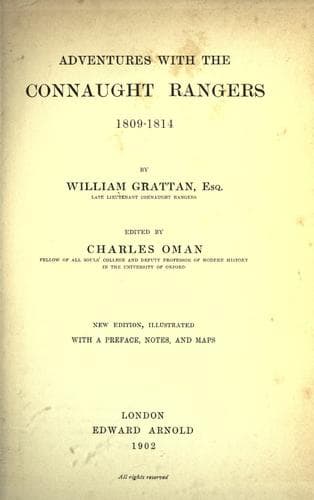
Adventures with the Connaught Rangers, 1809-1814Grattan, William
History
Adventures with the Connaught Rangers, 1809-1814
Grattan, William
Great Britain. Army. Regiment of Foot, 88th (Connaught Rangers); Peninsular War, 1807-1814 -- Personal narratives
Marshal Beresford, who arrived at the moment, galloped up at the head of
a brigade of the 5th Division, which he took out of the second line, and
for a moment covered the retreat of Cole’s troops; but this
force—composed of Portuguese—was insufficient to arrest the progress of
the enemy, who advanced in the full confidence of an assured victory;
and at this critical moment Beresford was carried off the field wounded.
Bonnet’s troops advanced, loudly cheering, while the entire of Cole’s
division and Spry’s brigade of Portuguese were routed. Our centre was
thus endangered. Boyer’s dragoons, after the overthrow of the French
left, countermarched and moved rapidly to the support of Bonnet; they
were close in the track of his infantry; and the fate of the battle was
still uncertain. The fugitives of the 7th and 4th French Divisions ran
to the succour of Bonnet, and by the time they had joined him his force
had indeed assumed a formidable aspect; and thus reinforced, it stood in
an attitude far different from what it would have done had Pack’s
brigade succeeded in its attack.
Lord Wellington, who saw what had taken place by the failure of Pack’s
troops, ordered up the 6th Division to the support of the 4th; and the
battle, although it was half-past eight o’clock at night, recommenced
with the same fury as at the onset.
Clinton’s division, consisting of six thousand bayonets, rapidly
advanced to assert its place in the combat, and to relieve the 4th from
the awkward predicament in which it was placed; they essayed to gain
what was lost by the failure of Pack’s troops in their feeble effort to
wrest the Arapilles height from a few brave Frenchmen; but they were
received by Bonnet’s troops at the point of the bayonet, and the fire
opened against them seemed to be threefold more heavy than that
sustained by the 3rd and 5th Divisions. It was nearly dark; and the
great glare of light caused by the thunder of the artillery, the
continued blaze of the musketry, and the burning grass, gave to the face
of the hill a novel and terrific appearance: it was one vast sheet of
flame, and Clinton’s men looked as if they were attacking a burning
mountain, the crater of which was defended by a barrier of shining
steel. But nothing could stop the intrepid valour of the 6th Division,
as they advanced with a desperate resolution to carry the hill. The
troops posted on the face of it to arrest their advance were trampled
down and destroyed at the first charge, and each reserve sent forward to
extricate them met with the same fate. Still Bonnet’s reserves, having
attained their place in the fight, and the fugitives from Thomières'
division joining them at the moment, prolonged the battle until dark.
Those men, besmeared with blood, dust, and clay, half naked, and some
carrying only broken weapons, fought with a fury not to be surpassed;
but their impetuosity was at length calmed by the bayonets of Clinton’s
troops, and they no longer fought for victory but for safety.
Public-domain text, read in full here on John Shaqi.
Reviews
Reviews
No reviews yet
Be the first to share your thoughts on this work.
Elsewhere in the archive
Join the Discussion
Join the discussion
Sign in to leave a comment or review.
Sign InorCreate an account