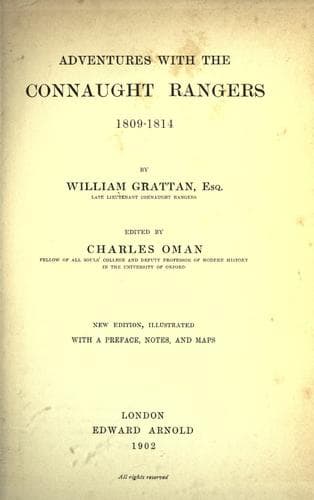
Adventures with the Connaught Rangers, 1809-1814Grattan, William
History
Adventures with the Connaught Rangers, 1809-1814
Grattan, William
Great Britain. Army. Regiment of Foot, 88th (Connaught Rangers); Peninsular War, 1807-1814 -- Personal narratives
After a
frightful struggle, they were driven from their last hold in confusion;
and a general and overwhelming charge, which the nature of the ground
enabled Clinton to make, carried this ill-formed mass of desperate
soldiers before him, as a shattered wreck borne along by the force of
some mighty current.
The mingled mass of fugitives fled to the woods and to the river for
safety, and under cover of the night succeeded in gaining the pass of
Alba over the Tormes. It was now ten o’clock at night: the battle was
ended. At this point it had been confined to a small space, and the
ground, trampled and stained deep, gave ample evidence of the havoc that
had taken place. Lord Wellington, overcome as he was with fatigue,
placed himself at the head of the 1st and Light Divisions and a brigade
of cavalry, and following closely the retreating footsteps of the enemy,
with those troops who had not fired a shot during the conflict, left the
remnant of his victorious army to sleep upon the field of battle they
had so hardly won.[35]
-----
Footnote 35:
The reader will note a considerable number of echoes from Napier in
this interesting and well-written chapter. But the narrative differs
in many points from that of Napier, especially as to the sequence of
events in that part of the field where the 88th served—notably as to
the moment at which Le Marchant’s dragoons charged. Grattan, being an
eye-witness, is probably nearer the truth than Napier, who was on the
other wing in the ranks of the Light Division. On the other hand, he
makes some slips, especially in stating that Pakenham’s _second_
assault was made upon Thomières' division instead of Maucune’s.
-----
CHAPTER XXI
Importance of the battle of Salamanca—Anecdotes of the 88th—Gallantry of
Captain Robert Nickle—Pursuit of the defeated army of Marshal
Marmont—French infantry in square broken and destroyed by
cavalry—March on Madrid—Frolics at St. Ildefonso—Sudden attack of
the French Lancers—Disgraceful conduct of the Portuguese Dragoons.
No battle since that of Marengo, in 1800, which opened the gates of
Vienna to the first Consul of France, had been fought whose consequences
ought to be more duly appreciated than the battle of Salamanca.
Public-domain text, read in full here on John Shaqi.
Reviews
Reviews
No reviews yet
Be the first to share your thoughts on this work.
Elsewhere in the archive
Join the Discussion
Join the discussion
Sign in to leave a comment or review.
Sign InorCreate an account