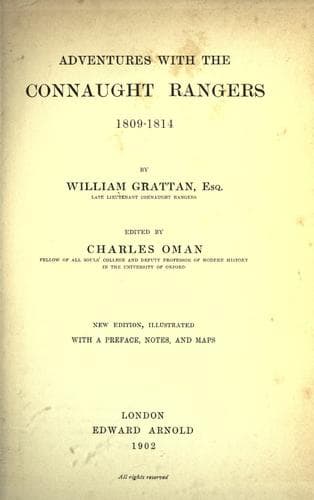
Adventures with the Connaught Rangers, 1809-1814Grattan, William
History
Adventures with the Connaught Rangers, 1809-1814
Grattan, William
Great Britain. Army. Regiment of Foot, 88th (Connaught Rangers); Peninsular War, 1807-1814 -- Personal narratives
Had that battle been lost, the disasters of the French army before
Moscow would have been of little account in the scale of the south, and
the imperial eagles would have soared with the same splendour, from
Madrid to Cadiz, or perhaps to Lisbon, as if no event of importance had
occurred beyond the Vistula. Portugal would have been then open to
invasion—the siege of Cadiz continued—the lines of Lisbon once more
invested—and what then?—why, the probable withdrawal of the British army
from the Peninsula. Portugal would be thus conquered—Spain laid
prostrate—England in utter dismay—and one hundred and fifty thousand
veteran French troops marched across the Pyrenees to take a part in the
combats of Lutzen and Leipsic. These would have been the results of a
defeat at Salamanca; and who is the man bold enough to say what the
results in the north of Europe would have been, had such an augmentation
of force—which would have been certain—joined Napoleon in the end of
1812, or even in the spring of 1813? As it was, he gained the battle of
Lutzen with a “green army.” Had he been backed by one hundred and fifty
thousand veteran troops from Spain, it requires no conjuror to tell what
the upshot would have been. These are the consequences which would have
followed a defeat at Salamanca. The gaining that battle placed matters
on a different footing. Portugal had nothing to dread—Soult was forced
to raise the siege of Cadiz—Madrid was evacuated, and Castille and
Andalusia were freed from the presence of a French force; but, above
all, no reinforcement of any account durst leave Spain to succour the
French army in the north of Europe; and the European struggle was
brought to a favourable result, and England saved from invasion—perhaps
ultimate conquest! But those services of the Peninsular army are
forgotten, and unrewarded.
At ten o’clock at night, Lord Wellington at the head of twelve thousand
infantry, and two thousand horsemen, was in pursuit of the routed and
discomfited army of Marmont, while the bulk of his own soldiers lay on
the field of battle. The results of that battle were—prisoners, one
hundred and thirty officers, seven thousand five hundred men, two
eagles, and fourteen guns. The field of battle was heaped with the
slain, and the total loss of the enemy may be estimated at seventeen
thousand: it has been reckoned by some writers as exceeding twenty
thousand; but I apprehend I am nearer the mark, and that seventeen
thousand was the outside. The dead and wounded on the side of the
British and Portuguese (for the Spanish army, commanded by Don Carlos de
España, lost _four men_!) were nearly five thousand; but the greater
number of the Portuguese either fell in their feeble attempt against the
Arapilles height, or by the shot that passed over the first line,
composed of British, which fell at random amongst the Portuguese placed
in the rear.
Public-domain text, read in full here on John Shaqi.
Reviews
Reviews
No reviews yet
Be the first to share your thoughts on this work.
Elsewhere in the archive
Join the Discussion
Join the discussion
Sign in to leave a comment or review.
Sign InorCreate an account