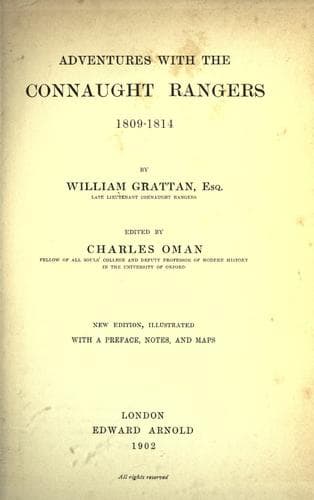
Adventures with the Connaught Rangers, 1809-1814Grattan, William
History
Adventures with the Connaught Rangers, 1809-1814
Grattan, William
Great Britain. Army. Regiment of Foot, 88th (Connaught Rangers); Peninsular War, 1807-1814 -- Personal narratives
I have to bring forward to the public eye, and the eye of posterity,
too, the character of the Peninsular soldiers, whether they be shown up
as men who were able to conquer the choicest legions of France, or as
men who would sell the most essential part of their dress for a glass of
brandy. No matter; they would have done both. Perfection is nowhere to
be found; and if the British soldier equalled the Frenchman in habits of
sobriety and caution, there could be no possible comparison between
them; but the retreat from Madrid and Burgos, which I am about to
relate, will give the reader a clearer insight into what I have just now
written: and I will here say, without the least fear of contradiction,
that the French soldier as far surpasses the British soldier in the
essential qualities requisite for general operations, as the latter
excels the Frenchman in a pitched battle. Let two armies of the two
nations be placed in circumstances the same, in advance or retreat. The
supply of provisions may be scanty or abundant—no matter which; both
armies, for argument sake, we will say, are placed in the same position
as to food. It may be asked what, then, is the great difference between
the soldiers of two nations who have been opposed to each other for so
many campaigns, and who ought to have profited by the better system
followed by either? It is this: the British soldier is not so moderate
in his appetites as his neighbour, and he wants the head, which the
other possesses, to control him. Give to a British regiment ten days',
nay five days' bread at a time, and, as may be necessary, five days'
rations of spirits; at the end of the second day—not the fifth, to which
period it ought to last—what quantity will be forthcoming? Not one half
ounce of bread, or half pint of spirits—half pint did I say! not one
thimbleful, nay, less than that, not one drop! Should the ration be
limited to bread, and in all armies, even the most temperate, a large
advance of spirits ought to be avoided, the danger would be the same in
any British army, because the soldiers would barter their bread for
spirits or wine, and would become quite as inefficient, as if they had
been supplied with both by our commissaries. Added to this, what means
had the soldiers of the Peninsular army to compete with the French in
celerity of cooking? None. The latter carried their cooking utensils on
their backs, while the camp-kettles for our troops were often leagues
distant when the meat arrived. This was the state of our army when the
retreat from Burgos on the one side, and Madrid on the other, commenced,
and it will be seen in the following pages how that retreat was
conducted, and how the subordinate officers of the army were blamed for
not performing a duty which was impossible; and for this reason was it
impossible, that the means did not rest with them. Our system was
altogether faulty, and no exertions of the junior, or even senior,
officers could remedy it.
Public-domain text, read in full here on John Shaqi.
Reviews
Reviews
No reviews yet
Be the first to share your thoughts on this work.
Elsewhere in the archive
Join the Discussion
Join the discussion
Sign in to leave a comment or review.
Sign InorCreate an account