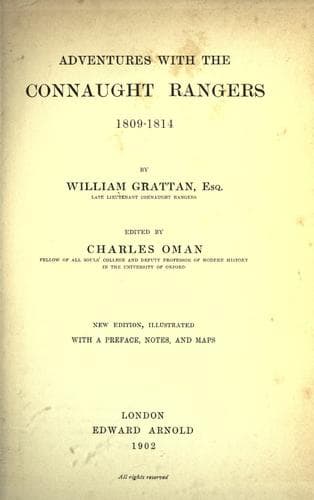
Adventures with the Connaught Rangers, 1809-1814Grattan, William
History
Adventures with the Connaught Rangers, 1809-1814
Grattan, William
Great Britain. Army. Regiment of Foot, 88th (Connaught Rangers); Peninsular War, 1807-1814 -- Personal narratives
Lord Wellington at length discovered this, and
in his next campaign profited by the example which the enemy showed him,
and which ought to have been followed long before.
On the 20th of October, 1812, the siege of Burgos was raised, and the
troops before it retired towards the Douro, while the portion of the
army which occupied Madrid made arrangements to join them when the
proper time should arrive. Accordingly, the fort of La China was mined,
the battering train found there removed, and all the necessary
arrangements for retreat were completed. On the 31st of October the army
quitted Madrid, and bivouacked in the Royal Park near the palace.
The conflagration of La China continued all night, and story after story
fell in until it became a heap of ruins. The following day, the 1st of
November, the advance of the French entered Madrid, and on that day our
army commenced its retreat upon Rodrigo and Portugal. On the side of
Burgos matters were in the same state. The attack against the citadel,
having failed, in default of means to carry it on, the army before it
broke up on the 20th of October, and by the admirable arrangements of
Lord Wellington, who took the command in person, gained two marches on
the enemy before he was aware of it. Nevertheless a vigorous pursuit
took place, and the Burgos army was closely pressed, until it reached
the heights of San Christoval, where it was joined by the troops that
had occupied Madrid.
Up to this time no serious disaster had occurred, although from the
heavy rains that had fallen, which rendered the roads nearly impassable,
and the scanty supply of rations which the troops received, it was
feared that, if Soult pressed on vigorously, our army would shortly
become much disorganised; but the Marshal took six days, that is to say,
from the 10th to the 16th of November, to examine the ground occupied by
the British General. On the 14th, our army was in battle array close to
the spot where we had fought the battle of Salamanca the July before,
but Soult, although at the head of 90,000 soldiers, and two hundred
pieces of cannon, declined the offer, and confined his operations to the
sending a brigade or two on the line of our communication with Rodrigo.
On the 17th, Lord Wellington commenced his march for the frontiers of
Portugal, and from that moment he was closely pursued by Marshal Soult.
The rain fell in torrents, almost without any intermission; the roads
could no longer be so called, they were perfect quagmires; the small
streams became rivers, and the rivers were scarcely fordable at any
point. In some instances the soldiers were obliged to carry their
ammunition boxes strapped on their shoulders to preserve them, while
passing a ford which on our advance was barely ankle deep. The baggage
and camp-kettles had left us; the former we never saw until we reached
Rodrigo, and the latter rarely reached us until two o’clock in the
morning, when the men, from fatigue, could make but little use of them.
Public-domain text, read in full here on John Shaqi.
Reviews
Reviews
No reviews yet
Be the first to share your thoughts on this work.
Elsewhere in the archive
Join the Discussion
Join the discussion
Sign in to leave a comment or review.
Sign InorCreate an account