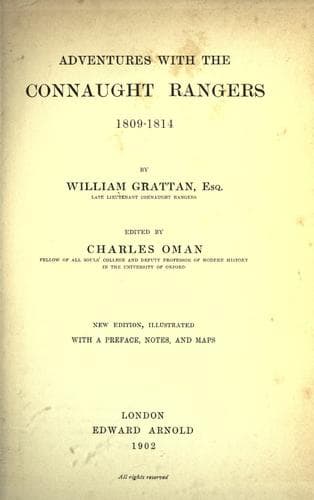
Adventures with the Connaught Rangers, 1809-1814Grattan, William
History
Adventures with the Connaught Rangers, 1809-1814
Grattan, William
Great Britain. Army. Regiment of Foot, 88th (Connaught Rangers); Peninsular War, 1807-1814 -- Personal narratives
Meanwhile, Captains Dunne, Dansey, and Oates had a severe struggle with
the French troops that occupied the rocks. Dunne’s sergeant (Brazil)
killed a Frenchman by a push of his halbert, who had nearly overpowered
his captain. Dansey was slightly wounded in four places, but it was said
at the time that he killed three Frenchmen—for he used a firelock. Oates
suffered less, as the men opposed to him were chiefly composed of those
that fled from Dunne and Dansey. Dunne’s company of Grenadiers, which at
the onset counted about sixty, lost either two or three-and-thirty, and
Dansey’s and Oates’s companies also suffered, but not to the same
amount. The French troops that defended those rocks were composed of the
4th Regiment and the Irish Brigade; several of the latter were left
wounded in the rocks, but we could not discover one Irishman amongst
them.[7]
-----
Footnote 7:
There is an error here. The Irish Brigade were not engaged; they were
in reserve, in the 8th corps.
-----
Lord Wellington, surrounded by his staff and some general officers, was
a close observer of this attack. He was standing on a rising ground in
rear of the 88th Regiment, and so close to that corps that Colonel
Napier of the 50th—who was on leave of absence—was wounded in the face
by a musket shot quite close to Lord Wellington. His Lordship passed the
warmest encomiums on the troops engaged, and noticed the conduct of
Captain Dansey in his despatch. It has been said, and I believe truly,
that Marshal Beresford, who was colonel of the 88th, expressed some
uneasiness when he saw his regiment about to plunge into this unequal
contest; but when they were mixed with Reynier’s men and pushing them
down the hill, Lord Wellington, tapping him on the shoulder, said,
“Well, Beresford, look at them _now_!”
While these events which I have described were taking place, Picton in
person took the command against the other division of Reynier’s corps
and had a sharp dispute with it at the pass of Saint Antonio; but
General Mackinnon, who led on the troops, never allowed it to make any
head. A shower of balls from Arentschildt’s battery deranged its
deployment, and a few volleys from the 74th British and the Portuguese
brigade of Champlemond totally routed this column before it reached the
top of the ridge. This attack was feeble in comparison with the one
directed against Wallace, and, besides, Picton’s force was vastly
superior to that commanded by Wallace, while the troops opposed to him
were little, if anything, more numerous. Picton had at this point five
companies of the 45th under Major Smyth, all the light companies of the
3rd Division, one company of the 60th Rifles, the 74th British and the
Portuguese brigade of Champlemond, besides Arentschildt’s battery of
guns. It is not, therefore, to be wondered at that Reynier made little
or no impression on Picton’s right.
Public-domain text, read in full here on John Shaqi.
Reviews
Reviews
No reviews yet
Be the first to share your thoughts on this work.
Join the Discussion
Join the discussion
Sign in to leave a comment or review.
Sign InorCreate an account