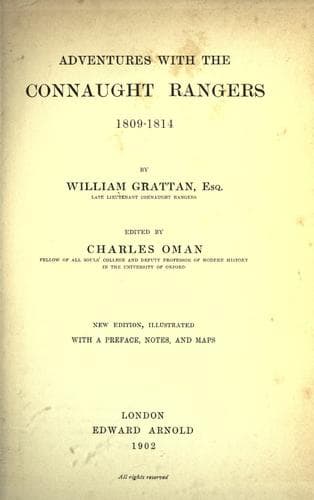
Adventures with the Connaught Rangers, 1809-1814Grattan, William
History
Adventures with the Connaught Rangers, 1809-1814
Grattan, William
Great Britain. Army. Regiment of Foot, 88th (Connaught Rangers); Peninsular War, 1807-1814 -- Personal narratives
We had now leisure to walk about and talk to each other on the events of
the morning, and look at the French soldiers in our front. They appeared
as leisurely employed cooking their rations as if nothing serious had
occurred to them, which caused much amusement to our men, some of whom
remarked that they left a few behind them that had got a “bellyful”
already. The rocks which had been forced by the three companies of the
88th presented a curious and melancholy sight; one side of their base
strewed with our brave fellows, almost all of them shot through the
head, while in many of the niches were to be seen dead Frenchmen, in the
position they had fought; while on the other side, and on the projecting
crags, lay numbers who, in an effort to escape the fury of our men, were
dashed to pieces in their fall!
Day at length began to close, and night found the two armies occupying
the ground they held on the preceding evening; our army, as then, in
utter darkness, that of the enemy more brilliant than the preceding
night, which brought to our recollection the remark of a celebrated
general when he saw bonfires through France after a signal defeat which
the troops of that nation had sustained. “Gad!” said the general, “those
Frenchmen are like flint-stones—the more you beat them the more fire
they make!”
Captain Seton, Ensign Owgan, and myself, with one hundred of the
Connaught Rangers, formed the picquet in advance of that regiment, and
immediately facing the outposts of the enemy in our front. The sentries
of each, as is customary in civilised armies, although within half-shot
range of each other, never fired except upon occasions of necessity.
Towards midnight Seton, a good and steady officer, went in front, for
the third time, to see that the sentinels which he himself had posted
were on the alert. He found all right; but upon his return to the main
body he missed his way, and happening in the dark to get too close to a
French sharpshooter, he was immediately challenged, but not thinking it
prudent to make any noise, in the shape of reply or otherwise, he held
his peace. Not so with the Frenchman, who uttered a loud cry to alarm
his companions, and discharged the contents of his musket at Seton; the
ball passed through his hat, but did no other injury, and he might have
rejoiced at his escape had the matter ended here; but the cry of the
sentinel and the discharge of his musket alarmed the others, and one
general volley from the line of outposts of both armies warned Seton
that his best and safest evolution would be to sprawl flat on his face
amongst the heath with which the hill was copiously garnished. He did
so, and as soon as the tumult had in a great degree abated, he got up on
his hands and knees and essayed to gain the ground which no doubt he
regretted he had ever quit. He was nearing the picquet fast, when the
rustling in the heath, increased by the awkward position in which he
moved, put us on the _qui vive_.
Public-domain text, read in full here on John Shaqi.
Reviews
Reviews
No reviews yet
Be the first to share your thoughts on this work.
Join the Discussion
Join the discussion
Sign in to leave a comment or review.
Sign InorCreate an account