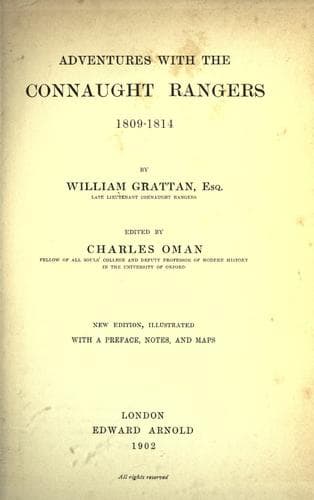
Adventures with the Connaught Rangers, 1809-1814Grattan, William
History
Adventures with the Connaught Rangers, 1809-1814
Grattan, William
Great Britain. Army. Regiment of Foot, 88th (Connaught Rangers); Peninsular War, 1807-1814 -- Personal narratives
It was the general opinion in the army that a battle in the
neighbourhood of Santarem would be the result of those manœuvres, and
this opinion was strengthened by Lord Wellington making a
_reconnoissance_ on the 19th; but although those expectations were
disappointed, the situation of the troops was much improved, and their
comforts increased. Our division occupied the town of Torres Vedras,
while the other corps were in the villages of Alenquer, Azambujo, and
Alcoentre. The French army foraged the country between Santarem and the
river Zezere. Santarem was much strengthened, and the two armies were
thus circumstanced at the end of November 1810.
Our fatigues being for a time at an end, we occupied ourselves in such
pursuits as each of us fancied. We had no unnecessary drilling, nor were
we tormented with that greatest of all _bores_ to an officer at any
time, but particularly on service, uniformity of dress. The consequence
was that every duty was performed with cheerfulness; the army was in the
highest state of discipline; and those gentlemen who had, or fancied
they had, a taste for leading the fashion, had now a fine opportunity of
bringing their talents into play.
With such latitude it is not to be wondered at that our appearance was
not _quite_ as uniform as some general officers would approve of; but
Lord Wellington was a most indulgent commander; he never harassed us
with reviews, or petty annoyances, which so far from promoting
discipline, or doing good in any way, have a contrary effect. A
corporal’s guard frequently did the duty at headquarters; and every
officer who chose to purchase a horse might ride on a march. Provided we
brought our men into the field well appointed, and with sixty rounds of
good ammunition each, he never looked to see whether their trousers were
black, blue, or grey; and as to ourselves, we might be rigged out in all
the colours of the rainbow if we fancied it. The consequence was, that
scarcely any two officers were dressed alike! Some with grey braided
coats, others with brown; some again liked blue; while many from choice,
or perhaps necessity, stuck to the “old red rag.” Overalls, of all
things, were in vogue, and the comical appearance of a number of
infantry officers loaded with leather bottoms to their pantaloons, and
huge chains suspended from the side buttons, like a parcel of troopers,
was amusing enough. Quantities of hair, a regular brutus, a pair of
mustachios, and screw brass spurs, were essential to a first-rate
_Count_, for so were our dandies designated. The “cut-down” hat, exactly
a span in height, was another _rage_; this burlesque on a _chapeau_ was
usually out-topped by some extraordinary-looking feather; while, again,
others wore their hats without any feather at all—and indeed this was
the most rational thing they did. In the paroxysm of a wish to be
singularly singular, a friend of mine shaved all the hair off the crown
Public-domain text, read in full here on John Shaqi.
Reviews
Reviews
No reviews yet
Be the first to share your thoughts on this work.
Join the Discussion
Join the discussion
Sign in to leave a comment or review.
Sign InorCreate an account