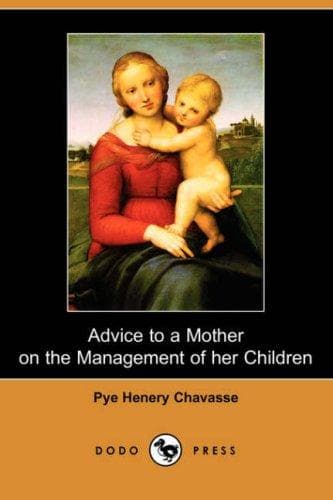
Advice to a Mother on the Management of Her Children — John Shaqi
Advice to a Mother on the Management of Her ChildrenChavasse, Pye Henry
Science
Advice to a Mother on the Management of Her Children
Chavasse, Pye Henry
Child care; Children -- Health and hygiene; Infants -- Health and hygiene
Not oftener than twice during the twenty four hours, and then only in
_small_ quantities at a time, as the stomach requires rest, and at the
same time, can manage to digest a little food better than it can a
great deal. Let me again urge upon you the importance, if it be at
all practicable, of keeping the child _entirely_ to the breast for the
first five or six months of his existence. Remember there is no
_real_ substitute for a mother's milk, there is no food so well
adapted to his stomach, there is no diet equal to it in developing
muscle, in making bone, or in producing that beautiful plump rounded
contour of the limbs, there is nothing like a mother's milk _alone_ in
making a child contented and happy, in laying the foundation of a
healthy constitution, in preparing the body for a long life, in giving
him tone to resist disease, or in causing him to cut his teeth easily
and well, in short, _the mothers milk is the greatest temporal
blessing an infant can possess_.
As a general rule, therefore, when the child and the mother are
tolerably strong, he is better _without artificial_ food until he have
attained the age of three or four months, then, it will usually be
necessary to feed him with _The Milk-water-and-sugar-of milk Food_
(see p 19) twice a day, so as gradually to prepare him to be weaned
(if possible) at the end of nine months. The food mentioned in the
foregoing Conversation will, when he is six or seven months old, be
the best for him.
36. _When the mother is not able to suckle her infant herself, what
ought to be done_?
It must first be ascertained, _beyond all doubt_, that a mother is not
able to suckle her own child Many delicate ladies do suckle their
infants with advantage, not only to their offspring, but to
themselves. "I will maintain," says Steele, "that the mother grows
stronger by it, and will have her health better than she would have
otherwise She will find it the greatest cure, and preservative for the
vapours [nervousness] and future miscarriages, much beyond any other
remedy whatsoever Her children will be like giants, whereas otherwise
they are but living shadows, and like unripe fruit, and certainly if a
woman is strong enough to bring forth a child, she is beyond all doubt
strong enough to nurse it afterwards."
Many mothers are never so well as when they are nursing, besides,
suckling prevents a lady from becoming pregnant so frequently as she
otherwise would. This, if she be delicate, is an important
consideration, and more especially if she be subject to miscarry. The
effects of miscarriage are far more weakening than those of suckling.
A hireling, let her be ever so well inclined, can never have the
affection and unceasing assiduity of a mother, and, therefore, cannot
perform the duties of suckling with equal advantage to the baby.
Public-domain text, read in full here on John Shaqi.
Reviews
Reviews
No reviews yet
Be the first to share your thoughts on this work.
Join the Discussion
Join the discussion
Sign in to leave a comment or review.
Sign InorCreate an account