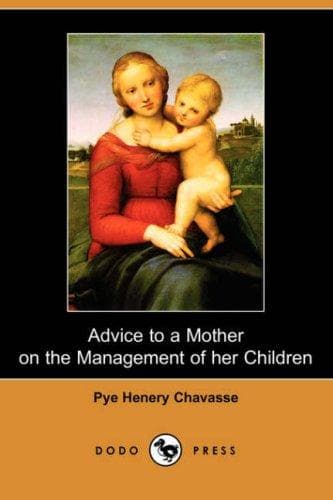
Advice to a Mother on the Management of Her Children — John Shaqi
Advice to a Mother on the Management of Her ChildrenChavasse, Pye Henry
Science
Advice to a Mother on the Management of Her Children
Chavasse, Pye Henry
Child care; Children -- Health and hygiene; Infants -- Health and hygiene
A wet-nurse is frequently allowed to remain in bed until a late hour
in the morning, and during the day to continue in the house, as if she
were a fixture! How is it possible that any one, under such
treatment, can continue healthy! A wet nurse ought to rise early, and,
if the weather and season will permit, take a walk, which will give
her an appetite for breakfast, and will make a good meal for her
little charge. This, of course, cannot, during the winter mouths, be
done; but even then, she ought, some part of the day, to take every
opportunity of walking out; indeed, in the summer time she should live
half the day in the open air.
She ought strictly to avoid crowded rooms; her mind should be kept
calm and unruffled, as nothing disorders the milk so much as passion,
and other violent emotions of the mind; a fretful temper is very
injurious, on which account you should, in choosing your wet-nurse,
endeavour to procure one of a mild, calm, and placid disposition.
[Footnote: "'The child is poisoned.'
'Poisoned! by whom?'
'By you. You have been fretting.'
'Nay, indeed, mother. How can I help fretting!'
'Don't tell me, Margaret. A nursing mother has no business to
fret. She must turn her mind away from her grief to the comfort that
lies in her lap. Know you not that the child pines if the mother vexes
herself?'"--_The Cloister and the Hearth_. By Charles Reade.]
A wet-nurse ought never to be allowed to dose her little charge either
with Godfrey's Cordial, or with Dalby's Carminative, or with Syrup of
White Poppies, or with medicine of any kind whatever. Let her
thoroughly understand this, and let there be no mistake in the
matter. Do not for one moment allow your children's health to be
tampered and trifled with. A baby's health is too precious to be
doctored, to be experimented upon, and to be ruined by an ignorant
person.
40. _Have the goodness to state at what age a child ought to be
weaned_?
This, of course, must depend both upon the strength of the child, and
upon the health of the parent; on an average, nine months is the
proper time. If the mother be delicate, it may be found necessary to
wean the infant at six months; or if he be weak, or labouring under
any disease, it may be well to continue suckling him for twelve
months; but after that time, the breast will do him more harm than
good, and will, moreover, injure the mother's health, and may, if she
be so predisposed, excite consumption.
41. _How would you recommend a mother to act when, she weans her
child_?
She ought, as the word signifies, do it gradually--that is to say, she
should, by degrees, give him less and less of the breast, and more and
more of artificial food; at length, she must only suckle him at night;
and lastly, it would be well for the mother either to send him away,
or to leave him at home, and, for a few days, to go away herself.
Public-domain text, read in full here on John Shaqi.
Reviews
Reviews
No reviews yet
Be the first to share your thoughts on this work.
Join the Discussion
Join the discussion
Sign in to leave a comment or review.
Sign InorCreate an account