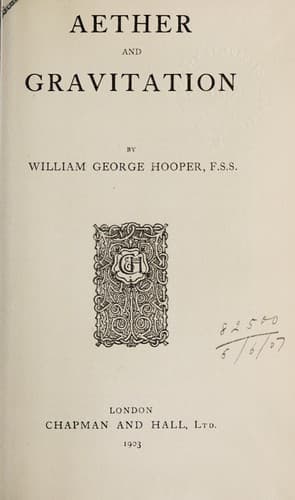
Ether (Space); Force and energy; Gravitation; Matter
If experience is any guide, we learn that the motion of the revolving
body is either partially or entirely transmitted to the liquid or
gaseous medium surrounding such a body. So far as our experience teaches
us anything, it teaches us that to that rule there is no exception, and
no experiment can be devised of any body revolving in water or a gaseous
medium as air, without that body imparting its rotation to the water or
the air. The atmosphere in relation to the earth is no exception to this
rule. We know that the earth has an equatorial circumference of about
24,000 miles, and that it revolves on its axis once every day, so that
at the equator the surface of the earth is whirling round in space at
the rate of 1000 miles per hour.
Try to conceive what the result would be if the atmosphere were
stationary at the earth's surface in the equatorial regions. It would
mean that any body on its surface would be whirled round at that rate,
while the atmosphere, being stationary, would exert a power equal to a
wind travelling at the rate of 1000 miles per hour.
Under the influence of such a hurricane, nothing could exist on the
surface of the earth at the equator, if the earth revolved on its axis
and the atmosphere did not participate in that motion. But the
atmosphere is gravitative, and being gravitative, it is not only held
bound to the earth as it revolves on its axis in its onward rush through
space, but accepts the revolving motion of the earth, with the result
that as the earth revolves on its axis, the atmosphere revolves also.
Thus a balloon at the equator if allowed to rise several hundred feet
above the surface could remain comparatively stationary if held by a
rope to overcome its tendency to rise, whereas such an event would be
impossible if the atmosphere failed to receive only half of the motion
of the earth's surface, as it would still have a power equal to that of
a wind blowing at the rate of 500 miles an hour. If, however, we come
further north, or go further south, then we find that the surface of the
earth does not have the same velocity as at the equator, with the result
that the atmosphere has not the same velocity either; consequently it
would travel slower in the temperate regions than in the equatorial
regions, and slower still at the poles than in the temperate regions.
We know by experiment what the effect of increased velocity has upon any
whirling body; it tends to enlarge the body at those parts where the
velocity is the greatest, the consequence being that the bulging out of
the atmosphere would be greatest at the equator. We find a similar
result in the shape of the earth, where the equatorial diameter is
greater than the polar diameter, because of the centrifugal force being
greatest in the equatorial regions.
Public-domain text, read in full here on John Shaqi.
Reviews
Reviews
No reviews yet
Be the first to share your thoughts on this work.
Elsewhere in the archive
Join the Discussion
Join the discussion
Sign in to leave a comment or review.
Sign InorCreate an account