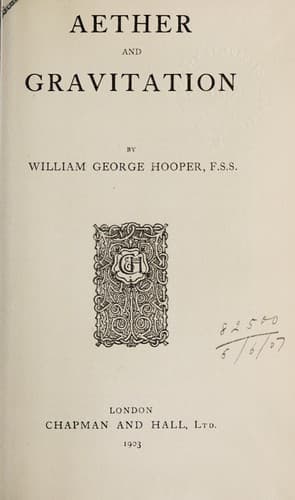
Ether (Space); Force and energy; Gravitation; Matter
We have, therefore, to apply these facts to the aetherial medium which
surrounds all planetary and stellar bodies in the same way as the
atmosphere does; and which, being also gravitative, is equally subject
to the same laws of motion. We have seen, therefore, that not only does
the earth revolve on its axis, but that the atmosphere revolves on its
axis also, and that the velocity of its revolution is greatest in the
equatorial regions, the atmosphere spreading or bulging out in those
parts more than in any other part of the earth's surface.
Let us suppose that the atmosphere extends 200 miles above the earth,
and that there we come to the pure Aether of universal space. In view of
the fact that Aether is Matter, and therefore gravitative, it is
reasonable and logical to conclude that exactly the same result follows
in relation to the atmosphere and the Aether at that height, as follows
in relation to the earth and the atmosphere 200 miles beneath.
Unless this view is accepted, we should then have our second Rule of
Philosophy violated, as we should have matter revolving in more rarefied
matter, and failing to impress upon that rarefied condition of matter
the motion either partially or wholly which it itself possesses; and
such a result being contradictory to all experience cannot be admitted
from a philosophical standpoint.
Therefore, the only solution is, that the rotating atmosphere imparts
some of its motion to the aetherial atmosphere, which in its turn
rotates, and that that rotation is governed by exactly the same
conditions as govern the relation that exists between the earth and the
atmosphere. Therefore the Aether in space associated with each planet or
satellite or sun or star, rotates with the rotating body, and that
rotation imparts to the Aether a greater bulging out in the equatorial
regions of the aetherial atmosphere than in any other part thereof. It
is interesting in relation to this point to note Herschel's view of the
effect of the rotation of any body upon the Aether. In his _Outlines of
Astronomy_, in a note, p. 358, he states: "Supposing the neighbourhood
of the sun to be filled with a material fluid; it is not conceivable
that the circulation of planets in it for ages should not have impressed
upon it some degree of rotation in their own direction, and this may
preserve them from the effects of accumulated resistance."
Public-domain text, read in full here on John Shaqi.
Reviews
Reviews
No reviews yet
Be the first to share your thoughts on this work.
Elsewhere in the archive
Join the Discussion
Join the discussion
Sign in to leave a comment or review.
Sign InorCreate an account