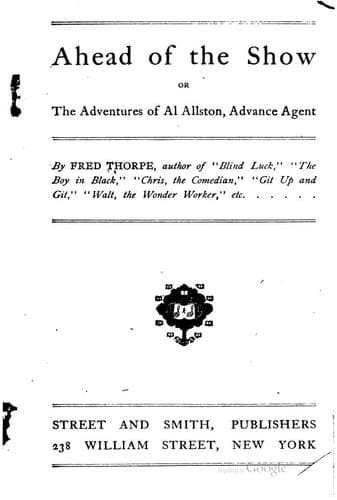
Ahead of the Show; Or, The Adventures of Al Allston, Advance AgentThorpe, Fred
History
Ahead of the Show; Or, The Adventures of Al Allston, Advance Agent
Thorpe, Fred
Performing arts -- United States -- History -- 19th century -- Fiction
"Never mind whether he is or not," was the actress' reply. "I wish you
good-evening, Wattles. I don't want your two weeks' notice. I wouldn't
play in your company again for ten times the miserable salary you paid
me. Find some one else to play the part to-morrow night or shut up the
house."
With these words and a vindictive glance, the woman left the theater,
slamming the stage door violently behind her.
Mr. Wattles drew a long breath of relief.
"I'm glad to get rid of her," he said. "This isn't the first time she
and I have had words. I'll have another woman here to play the part
to-morrow night, or I'll cut it out altogether; it isn't of any
importance, anyhow. And, I say, I believe that Mrs. Anderson has the
making of an actress in her, after all. She's as good a kicker as if she
had been in the business all her life. No danger of her suffering from
stage fright; she has too good an opinion of herself. Well, I must go
around to the front now. Come with me and see how things look."
The house was, as Al had predicted, packed to the doors; even standing
room was at a premium. Such an audience had never been seen in the opera
house before.
The souvenir spoons had proved a great success; everyone was extolling
the liberality of the management.
"This is immense," chuckled Mr. Wattles, rubbing his hands. "Allston,
you are a trump. I wish you could do this in every town we visit."
"Well, I'll do my best to repeat the success," smiled Al. "What can't be
done in one way can in another."
"And you're the lad who can do it. But the curtain is going up. I hope
Mrs. Anderson will be all right. She comes on in less than five minutes.
Come up to the manager's box now; it's the only place in the house where
we can get a seat."
The two elbowed their way through the crowd; and, not without some
difficulty, reached the box in question. They had hardly taken their
seats when Mrs. Anderson stepped upon the stage. Her appearance was the
signal for a perfect whirlwind of applause.
"Well," said Mr. Wattles, as the lady stood bowing and smiling, "she is
a good-looker, anyway. She's as well made up as if she'd been in the
profesh for years; and, by Jove! she's as cool as a veteran! What a
reception! Irving himself couldn't ask for a better one."
In fact, it was nearly or quite three minutes before the debutante could
go on with her part. By this time the stage was half filled with "floral
tributes," one huge piece being from the board of aldermen. When the
mayor, who was seated in an opposite box, saw this, his face, which had
until then worn a rather gloomy expression, lighted up, and he began to
manifest some signs of interest in the performance.
As Mr. Wattles had said, the part that had been assigned to Mrs.
Anderson was one of very little importance. It would have been difficult
to make a failure of it. The lady recited her lines well, and when she
left the stage she was furiously applauded.
Public-domain text, read in full here on John Shaqi.
Reviews
Reviews
No reviews yet
Be the first to share your thoughts on this work.
Join the Discussion
Join the discussion
Sign in to leave a comment or review.
Sign InorCreate an account