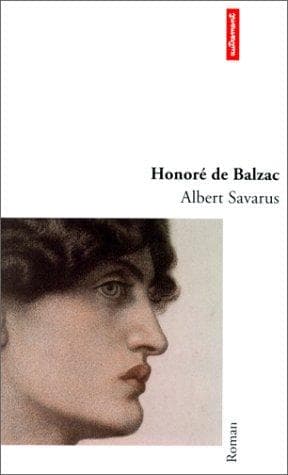
France -- Social life and customs -- 19th century -- Fiction; French fiction -- Translations into English
Produced by John Bickers, and Dagny
ALBERT SAVARUS
By Honore de Balzac
Translated by Ellen Marriage
DEDICATION
To Madame Emile Girardin
ALBERT SAVARUS
One of the few drawing-rooms where, under the Restoration, the
Archbishop of Besancon was sometimes to be seen, was that of the Baronne
de Watteville, to whom he was particularly attached on account of her
religious sentiments.
A word as to this lady, the most important lady of Besancon.
Monsieur de Watteville, a descendant of the famous Watteville, the most
successful and illustrious of murderers and renegades--his extraordinary
adventures are too much a part of history to be related here--this
nineteenth century Monsieur de Watteville was as gentle and peaceable
as his ancestor of the _Grand Siecle_ had been passionate and turbulent.
After living in the _Comte_ (La Franche Comte) like a wood-louse in the
crack of a wainscot, he had married the heiress of the celebrated house
of Rupt. Mademoiselle de Rupt brought twenty thousand francs a year in
the funds to add to the ten thousand francs a year in real estate of the
Baron de Watteville. The Swiss gentleman’s coat-of-arms (the Wattevilles
are Swiss) was then borne as an escutcheon of pretence on the old shield
of the Rupts. The marriage, arranged in 1802, was solemnized in 1815
after the second Restoration. Within three years of the birth of a
daughter all Madame de Watteville’s grandparents were dead, and their
estates wound up. Monsieur de Watteville’s house was then sold, and
they settled in the Rue de la Prefecture in the fine old mansion of the
Rupts, with an immense garden stretching to the Rue du Perron. Madame
de Watteville, devout as a girl, became even more so after her marriage.
She is one of the queens of the saintly brotherhood which gives the
upper circles of Besancon a solemn air and prudish manners in harmony
with the character of the town.
Monsieur le Baron de Watteville, a dry, lean man devoid of intelligence,
looked worn out without any one knowing whereby, for he enjoyed the
profoundest ignorance; but as his wife was a red-haired woman, and of a
stern nature that became proverbial (we still say “as sharp as Madame
de Watteville”), some wits of the legal profession declared that he had
been worn against that rock--_Rupt_ is obviously derived from _rupes_.
Scientific students of social phenomena will not fail to have observed
that Rosalie was the only offspring of the union between the Wattevilles
and the Rupts.
Public-domain text, read in full here on John Shaqi.
Reviews
Reviews
No reviews yet
Be the first to share your thoughts on this work.
Join the Discussion
Join the discussion
Sign in to leave a comment or review.
Sign InorCreate an account