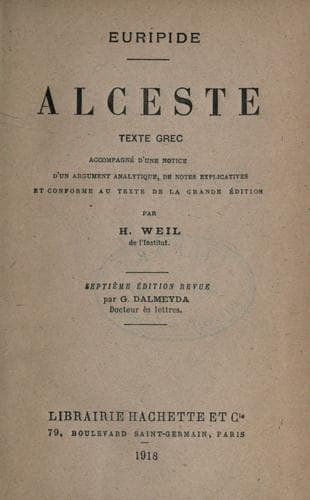
Alcestis, Queen, consort of Admetus, King of Pherae -- Drama
ADMÊTUS, _King of Pherae in Thessaly_.
ALCESTIS, _daughter of Pelias, his wife_.
PHERÊS, _his father, formerly King but now in retirement_.
TWO CHILDREN, _his son and daughter_.
A MANSERVANT _in his house_.
A HANDMAID.
The Hero HERACLES.
The God APOLLO.
THANÁTOS _or_ DEATH.
CHORUS, _consisting of Elders of Pherae_.
"_The play was first performed when Glaukînos was Archon, in the 2nd
year of the 85th Olympiad_ (438 B.C.). _Sophocles was first,
Euripides second with the Cretan Women, Alcmaeon in Psophis, Telephus and
Alcestis.... The play is somewhat Satyric in character._"
ALCESTIS
_The scene represents the ancient Castle of_ ADMETUS _near Pherae
in Thessaly. It is the dusk before dawn_; APOLLO, _radiant in the
darkness, looks at the Castle._
APOLLO.
Admetus' House! 'Twas here I bowed my head
Of old, and chafed not at the bondman's bread,
Though born in heaven. Aye, Zeus to death had hurled
My son, Asclepios, Healer of the World,
Piercing with fire his heart; and in mine ire
I slew his Cyclop churls, who forged the fire.
Whereat Zeus cast me forth to bear the yoke
Of service to a mortal. To this folk
I came, and watched a stranger's herd for pay,
And all his house I have prospered to this day.
For innocent was the Lord I chanced upon
And clean as mine own heart, King Pheres' son,
Admetus. Him I rescued from the grave,
Beguiling the Grey Sisters till they gave
A great oath that Admetus should go free,
Would he but pay to Them Below in fee
Another living soul. Long did he prove
All that were his, and all that owed him love,
But never a soul he found would yield up life
And leave the sunlight for him, save his wife:
Who, even now, down the long galleries
Is borne, death-wounded; for this day it is
She needs must pass out of the light and die.
And, seeing the stain of death must not come nigh
My radiance, I must leave this house I love.
But ha! The Headsman of the Pit, above
Earth's floor, to ravish her! Aye, long and late
He hath watched, and cometh at the fall of fate.
_Enter from the other side_ THANATOS; _a crouching black-haired and
winged figure, carrying a drawn sword. He starts in revulsion on
seeing_ APOLLO.
THANATOS.
Aha!
Why here? What mak'st thou at the gate,
Thou Thing of Light? Wilt overtread
The eternal judgment, and abate
And spoil the portions of the dead?
'Tis not enough for thee to have blocked
In other days Admetus' doom
With craft of magic wine, which mocked
The three grey Sisters of the Tomb;
But now once more
I see thee stand at watch, and shake
That arrow-armèd hand to make
This woman thine, who swore, who swore,
To die now for her husband's sake.
APOLLO.
Fear not.
I bring fair words and seek but what is just.
THANATOS (_sneering_)
And if words help thee not, an arrow must?
APOLLO.
'Tis ever my delight to bear this bow.
THANATOS.
And aid this house unjustly? Aye, 'tis so.
APOLLO.
I love this man, and grieve for his dismay.
THANATOS.
And now wilt rob me of my second prey!
Public-domain text, read in full here on John Shaqi.
Reviews
Reviews
No reviews yet
Be the first to share your thoughts on this work.
Join the Discussion
Join the discussion
Sign in to leave a comment or review.
Sign InorCreate an account