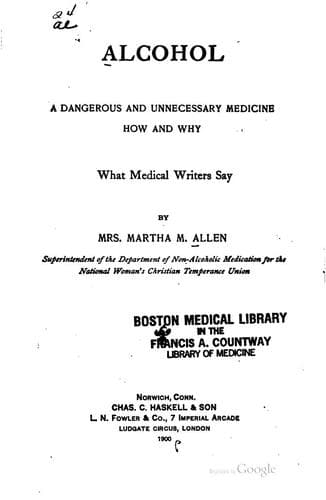
Alcohol: A Dangerous and Unnecessary Medicine, How and Why: What Medical Writers SayAllen, Martha Meir
Science
Alcohol: A Dangerous and Unnecessary Medicine, How and Why: What Medical Writers Say
Allen, Martha Meir
Alcohol -- Physiological effect; Temperance
"Many of these 'feeble hearts' mean too little exercise, very
often also, too much or improper food and drink.
"The best remedies are cold sponging (according to the season);
avoidance of coddling; plain, wholesome food; abstinence from
tea, hot drinks and condiments; regular out-of-doors exercise
and all similar true _tonic_ measures."
Dr. Kellogg says:--
"Persons subject to attacks of _angina pectoris_ should carry
with them a small bottle containing a sponge saturated with
nitrite of amyl, and place it to the nose when necessary.
"Sympathetic palpitation may be relieved by bending the head
downward, allowing the arms to hang down. The effect of this
measure is increased by holding the breath a few seconds while
bending over. Another ready means of relief is to press strongly
upon the large arteries on either side of the neck.
"Palpitation of the heart is often mistaken for real organic
disease of the organ. * * * * * A careful regulation of the diet
is in most cases all that is necessary to effect a cure."
Dr. Edmunds, of London, was asked during a medical discussion what he
thought of the use of alcohol in heart disease. His answer is embodied
in the following:--
"With regard to the use of brandy in cases of heart disease, he
was convinced it was a mistake to use it in such cases. There
were many forms of heart disease, but the most common kind arose
from the heart being too fat. Excess of fat debilitated the
heart and injured its working, just as a piece of wax attached
to a tuning fork would impair its usefulness. In such cases he
dieted his patients in order to reduce their weight. Every dose
of brandy taken for heart disease increased the evil. The moment
brandy was taken for heart disease, or any other chronic
complaint of a similar kind, the disease was increased. If
doctors recommended alcohol to their patients, he had been asked
what abstainers should do. In such cases, as had been suggested,
he thought the patients might ask what the alcohol was to do for
them, and if the reply was not satisfactory, they should get
another doctor."
Dr. T. D. Crothers, of Hartford, Conn., has deduced some valuable facts
from his experiments with the sphygmograph, upon the action of the
heart. He has found by repeated experiments that while alcohol
apparently increases the force and volume of the heart's action, the
irregular tracings of the sphygmograph show that the real vital force
is diminished, and hence its apparent stimulating power is deceptive.
Dr. C. W. Chapman, of the National Hospital for Diseases of the Heart,
wrote in the _Lancet_:--
"The very thing (alcohol) which they supposed had kept their
heart going was responsible for many of its difficulties."
Of cases of palpitation and irregularity caused by business anxieties or
indigestion, he said:--
Public-domain text, read in full here on John Shaqi.
Reviews
Reviews
No reviews yet
Be the first to share your thoughts on this work.
Elsewhere in the archive
Join the Discussion
Join the discussion
Sign in to leave a comment or review.
Sign InorCreate an account