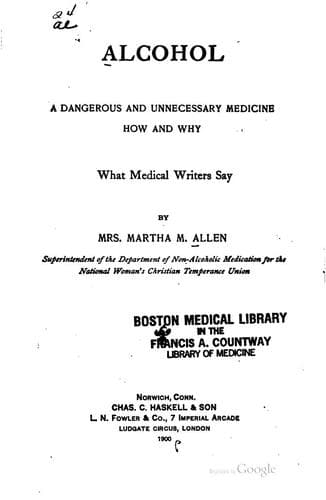
Alcohol: A Dangerous and Unnecessary Medicine, How and Why: What Medical Writers SayAllen, Martha Meir
Science
Alcohol: A Dangerous and Unnecessary Medicine, How and Why: What Medical Writers Say
Allen, Martha Meir
Alcohol -- Physiological effect; Temperance
"To give alcohol is only to add fuel to the fire."
HEART FAILURE:--"In cases of cardiac weakness, the thing needed
is not simply an increased rate of movement of the heart, or an
increased volume of the pulse, but an increased movement of the
blood current throughout the entire system. In the application
of any agent for the purpose of affording relief in a condition
of this kind, the peripheral heart as well as the central organ
must be taken into consideration. In fact, the whole circulatory
system must be regarded as one. The heart and the arteries are
composed of essentially the same kind of tissue, and have
practically the same functions. The arteries as well as the
heart are capable of contracting.
"Both the heart and the arteries are controlled by excitory and
inhibitory nerves. These two classes of nerves are kindred in
structure and in origin, the vagus and the vasodilators being
medullated, while the accelerators of the heart and the
vasoconstrictors of the arteries are non-medullated and pass
through the sympathetic ganglia on the way to their
distribution.
"Winternitz and other therapeutists have frequently called
attention to the value of cold as a cardiac stimulant or tonic.
The tonic effect of this agent is greater than that of any
medicinal agent which can be administered. The cold compress
applied over the cardiac area of the chest may well replace
alcohol as a heart tonic. The thing necessary to encourage the
heart's action is not merely relaxation of the peripheral
vessels, but, as Winternitz has shown, increased activity of the
peripheral circulation in the skin, muscles and elsewhere.
Alcohol paralyzes the vasoconstrictors, and so dilates the small
vessels and lessens the resistance of the heart action; but at
the same time it lessens the activity of the nerve centres which
control the heart, diminishes the power of the heart muscle, and
lessens that rhythmical activity of the small vessels whereby
the circulation is so efficiently aided at that portion of the
blood circuit most remote from the heart. A continuous cold
application applied to that portion of the chest overlying the
heart stimulates the nerves controlling the walls of the
vessels, and at the same time energizes the corresponding
cardiac nerves. It is wise to remember that the vasoconstrictor
nerves are one in kind with the excitor nerves of the heart,
while the vasodilators are in like manner associated with the
vagus. With this in mind, it is clear that while alcohol
paralyzes the vasoconstrictors, it at the same time weakens the
nerves which initiate and maintain the activity of the heart;
while, on the other hand, cold excites to activity those nerves
which produce the opposite effect.
Public-domain text, read in full here on John Shaqi.
Reviews
Reviews
No reviews yet
Be the first to share your thoughts on this work.
Elsewhere in the archive
Join the Discussion
Join the discussion
Sign in to leave a comment or review.
Sign InorCreate an account