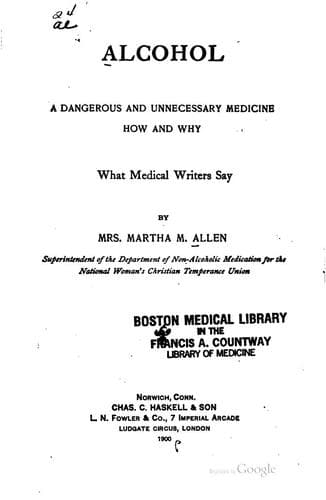
Alcohol: A Dangerous and Unnecessary Medicine, How and Why: What Medical Writers SayAllen, Martha Meir
Science
Alcohol: A Dangerous and Unnecessary Medicine, How and Why: What Medical Writers Say
Allen, Martha Meir
Alcohol -- Physiological effect; Temperance
'I find that infants and young children are practically exempt
from the disease, and the liability increases with age. In my
own experience, which has since 1889 amounted to an aggregate of
3,000 cases, alcoholic stimulants have appeared to be usually of
little or no value; their usual stimulating effect does not seem
to be realized in this condition. Unless malarial complications
exist quinine appears of no benefit, and then should not be used
in larger than two grain doses. Large doses depress the weakened
heart, and in all cases increase the terrible confusion and
headache constantly present in severe cases.
'From the views I entertain of its pathology, and from the
terrible fatality which has attended the extensive use of the
coal tar derivatives in treatment of _la grippe_, I argue that
the manner in which they have been prescribed in the beginning
of the disease, to reduce fever, and relieve the often intense
suffering, lowers the heart's action, which is already
sufficiently incapacitated by the toxic agent producing the
disease.
'The intention is usually to stimulate later, but later is in
many cases unfortunately too late. The heart being overwhelmed
by the poison, and by the added depression of all coal tar
preparations, cannot keep up the pulmonary circulation. The
swelling of the lungs increases, and the result is fatal.
'I am aware of the weight of authority for their administration
and of the relief they afford, but am just as well assured that
were their use discontinued, the greatly increased death-rate
from _la grippe_ would cease to appear.
'These coal tar remedies are being used everywhere, and the
medical journals recommend them despite the fatal results. They
are being used every hour in the day in Syracuse, and, as a
result, are knocking out good people. Among the most popular
coal tar derivatives I might mention anti-kamnia,
salol-phenacetine, anti-pyrine and salicylate of soda.
'Prognosis is favorable at all ages. Patients should be kept
warm, and perfectly quiet in bed, and supplied with such
nutritious and easily digested food, at frequent intervals, as
the partially paralyzed stomach can take care of. All
nourishment must be fluid and warm rather than cold.'"
The _Journal of Inebriety_ for April, 1889, says:--
"The present epidemic of influenza has proved to be very fatal
in cases of moderate and excessive alcoholic drinkers.
Public-domain text, read in full here on John Shaqi.
Reviews
Reviews
No reviews yet
Be the first to share your thoughts on this work.
Elsewhere in the archive
Join the Discussion
Join the discussion
Sign in to leave a comment or review.
Sign InorCreate an account