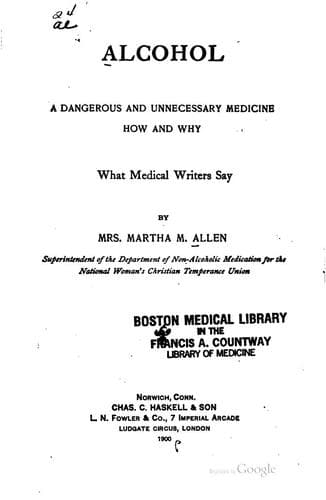
Alcohol: A Dangerous and Unnecessary Medicine, How and Why: What Medical Writers SayAllen, Martha Meir
Science
Alcohol: A Dangerous and Unnecessary Medicine, How and Why: What Medical Writers Say
Allen, Martha Meir
Alcohol -- Physiological effect; Temperance
"Pneumonia is the most common sequel, breaking out suddenly, and
terminating fatally in a few days. Heart failure and profound
exhaustion, is another fatal termination. One case was reported
to me of an inebriate, who, after a full outbreak of all the
usual symptoms, drank freely of whisky and became stupid and
died. It was uncertain whether cerebral hemorrhage had taken
place, or the narcotism of the alcohol had combined with the
disease and caused death.
"A physician appeared to have unusual fatality in the cases of
this class under his care.
"It was found that he gave some form of alcohol freely, on the
old theory of stimulation. Another physician gave all drinking
cases with this disease alcohol, on the same theory, and had
equally fatal results. It has been asserted that alcohol, as an
antiseptic, was useful in these bacterial epidemics, but its use
has been followed by greater depression, and many new and
complex symptoms. The frequent half domestic and professional
remedy, hot rum and whisky, has been followed by more serious
symptoms, and a protracted convalescence. Many facts have been
reported showing the danger of alcohol as a remedy, also the
fatality in cases of inebriates who were affected with this
disease.
"The first most common symptom seems to be heart exhaustion and
feebleness, then from the catarrhal and bronchial irritation,
pneumonia often follows."
The vapor or Turkish bath is the best means of "breaking up" this
disease, together with hot lemonade and rest in bed for a day or two.
The inhalation of hot steam should be tried when there is much bronchial
irritation.
LIFE-SAVING STATIONS, THE USE OF ALCOHOL IN:--"There is no
possible useful place for alcoholic liquors in connection with a
life-saving station. Applied externally the rapid evaporation of
alcohol reduces the temperature; taken internally it diminishes
the efficiency of both respiration and circulation, and by
increasing congestion of the kidneys it directly increases the
danger of secondary bad effects from exposures of any kind. To
restore warmth and circulation to the surface, light, rapid
friction and the wrapping with dry flannel is the safest,
cheapest and most efficient, while free breathing of fresh air,
and frequent small doses of milk, beef-tea, ordinary tea or
coffee, or even simple water, will afford the greatest amount of
strength and endurance, and leave the least secondary bad
consequences. It is just as easy to keep at hand a jug or flask
of any one of the articles named as it is to keep a flask of
whisky or brandy. There is no need of keeping them hot, as they
act well at any temperature at which they can be drunk."--DR. N.
S. DAVIS, Chicago.
Public-domain text, read in full here on John Shaqi.
Reviews
Reviews
No reviews yet
Be the first to share your thoughts on this work.
Elsewhere in the archive
Join the Discussion
Join the discussion
Sign in to leave a comment or review.
Sign InorCreate an account