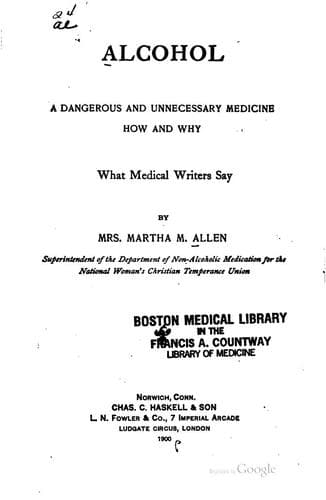
Alcohol: A Dangerous and Unnecessary Medicine, How and Why: What Medical Writers SayAllen, Martha Meir
Science
Alcohol: A Dangerous and Unnecessary Medicine, How and Why: What Medical Writers Say
Allen, Martha Meir
Alcohol -- Physiological effect; Temperance
"The symptoms in the dogs were all alike, dyspnea, increasing as
the inflammation increased, until the accessory muscles of
respiration were called into play. The stethoscope showed that
air had great difficulty in entering the bronchi and air
vesicles, and showed also the tumultuous beating of the heart
in pumping blood through the lung. It was impossible to take the
temperatures. Post-mortem examinations showed the lungs dark,
congested and solid in some places. The air passages were filled
with frothy, bloody mucus, even in the dog that died in five
minutes. On section, the lungs were dark, congested, and full of
bloody mucus. This shows how acutely sensitive the respiratory
passages are to the action of alcohol. On microscopic
examination of the lungs, the air tubes and vesicles were found
filled with immense numbers of red and white corpuscles and much
mucus. The same picture was presented as in a slide from the
lungs of a broncho-pneumonic child.
"The striking similarity between the two is enough to prove that
the pathological condition is the same, and that alcohol has
produced a lesion very closely resembling, if not absolutely
like, that of broncho-pneumonia in the human subject. This to
some extent explains why drunkards attacked by pneumonia succumb
more readily than the temperate. The sensitive lung tissue is
enveloped in alcohol--flowing through the capillaries of the
lung on one side, and exhaled, filling the air vesicles and
tubes on the other. The condition must create a state of
semi-engorgement or of mild inflammation, similar to the
drunkard's red nose, or his engorged gastric mucous membrane.
Such a state will reduce the vitality of the pulmonary tissue,
and its power of resistance to external influences. Add to this
an inflammation such as a pneumonia, and the lungs find
themselves unable to stand the pressure."
As previous chapters contain much showing the reasons why alcohol is
dangerous in pneumonia, space need not be taken here to do more than
indicate briefly some points of non-alcoholic treatment.
Pneumonia is generally supposed to result from a cold; it is ushered in
by the symptoms of a chill, followed by fever, headache, shortness of
breath, pain in chest, etc. It sometimes occurs as a complication of
typhoid fever and other acute diseases.
"It is not a very fatal disease in young and healthy subjects,
but in weak children, old persons and habitual drinkers, it is a
very fatal malady."
_Nature Cure_ recommends a vapor bath immediately upon the appearance of
the first symptoms, together with copious drinking of hot lemonade, and
a good supply of pure fresh air in the room, together with the
application of alternating hot and cold compresses, _and no drugs_.
Dr. Kellogg says:--
Public-domain text, read in full here on John Shaqi.
Reviews
Reviews
No reviews yet
Be the first to share your thoughts on this work.
Elsewhere in the archive
Join the Discussion
Join the discussion
Sign in to leave a comment or review.
Sign InorCreate an account