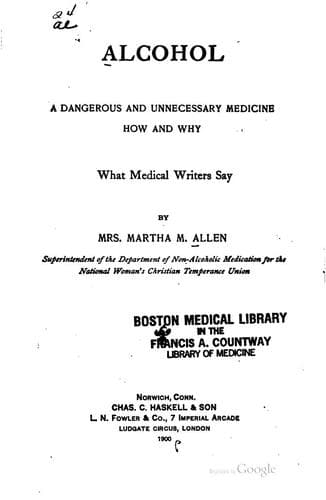
Alcohol: A Dangerous and Unnecessary Medicine, How and Why: What Medical Writers SayAllen, Martha Meir
Science
Alcohol: A Dangerous and Unnecessary Medicine, How and Why: What Medical Writers Say
Allen, Martha Meir
Alcohol -- Physiological effect; Temperance
"Cool compresses or ice-bags, alternated every three hours by
hot fomentations for ten minutes, should be applied to the
chest, particularly to the affected side, the seat of pain. The
hot fomentations relieve the pain, and the cold compresses check
the diseased process. The compresses should be wrung out of cold
water, and changed every five to eight minutes, or as often as
they become warm. Although the cool compresses are not usually
liked by the patient, they will soon give relief if their use is
continued, and they do much towards shortening the course of the
disease. Care should be taken to keep the patient's body from
being wet except where the treatment is applied. The cold
compress is much used in the large hospitals of Germany. When
the pulse becomes as rapid as 95 to 110 or more, cool sponging,
the wet-sheet pack, the cool full bath or the cool enema should
be employed. When much chilliness is produced by the contact of
water with the skin, the cold enema is a most admirably useful
measure. The amount of water required is from half a pint to a
pint. The temperature may be 40 to 60 degrees. The apartment
should be kept as cool as possible without discomfort, and an
abundance of fresh air should be continually supplied.
"The diet of the patient should consist of milk, oatmeal gruel,
ripe fruit, and similar easily digested food. No meat, eggs or
other stimulating food should be allowed.
"Discontinue the cold treatment after the first twenty-four to
forty-eight hours. If the surface is cold, apply hot sponging or
a hot pack. Avoid causing chilliness."
PRE-NATAL INFLUENCE OF ALCOHOL:--"The use of beer as a medicine
during pregnancy is without doubt perilous to the health and
vigor of the offspring. Children born under such conditions are
sickly and feeble, and suffer from disease more severely than
others, or die early. Alcoholic prescriptions to pregnant women
are, from all present knowledge of the facts, both dangerous and
reprehensible in the highest degree."--DR. T. D. CROTHERS,
Hartford, Conn.
"M. Fere, an eminent French physician, recently reported to the
Biological Society of Paris the results of experiments which he
had been conducting for the purpose of throwing light upon this
question. These experiments demonstrate that the exposure of
hen's eggs to the influence of the vapor of alcohol, previous to
incubation, retards the development of the embryo, and favors
the production of malformations. It is evident from these
experiments that alcohol may act directly upon the embryo when
there is no marked influence of alcoholism in the parent."
Public-domain text, read in full here on John Shaqi.
Reviews
Reviews
No reviews yet
Be the first to share your thoughts on this work.
Elsewhere in the archive
Join the Discussion
Join the discussion
Sign in to leave a comment or review.
Sign InorCreate an account