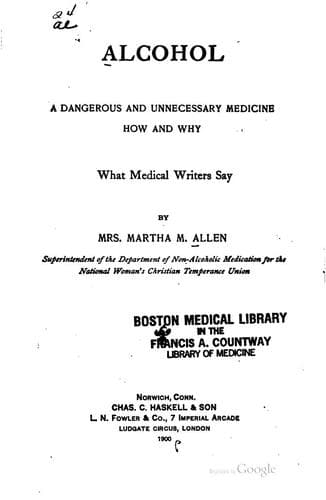
Alcohol: A Dangerous and Unnecessary Medicine, How and Why: What Medical Writers SayAllen, Martha Meir
Science
Alcohol: A Dangerous and Unnecessary Medicine, How and Why: What Medical Writers Say
Allen, Martha Meir
Alcohol -- Physiological effect; Temperance
Dr. Kate Lindsay, of Battle Creek Sanitarium and Hospital, contributed
an article upon Typhoid Fever to the _Bulletin of the A. M. T. A._ for
January, 1896, from which a few notes are here taken:--
"The chief toxic centre is evidently the intestinal tract,
especially the termination of the ileum. The ulcerations,
necroses, perforations and hemorrhages are most frequently found
in the last twelve inches of the small intestine, and may extend
into the large intestine. The ulcerated surface and open vessels
increase the facility with which the poison finds entrance into
the circulation. The microbes, blood clots, necrosed tissue and
pus, furnish abundant supplies of toxic matter, which,
saturating the system, over-power and stop the activity of the
functions of all the organs of the body, causing degeneration of
tissues. Death is said to take place from heart, lung or brain
failure, but the failure involves every other organ as well.
"Regarding the intestinal tract as any other abscess at this
time, the physician should seek for methods of treatment or
remedies which will remove the morbid matters, and destroy, or
at least inhibit their action, thus decreasing the fever and
stimulating the circulation. Secondary toxic centres often
develop in the course of this disease, notably in the glands,
lungs and dependent organs, the hypostatic congestion resulting
from lying in one position, causing stasis of blood, death and
necrosis of tissue, both of the external and internal organs.
All vessels connected with the dying tissues carry toxins to
other parts of the body. Suppurating glands, and phlebitis of
the femoral veins are examples of this secondary infection, and
are accountable for the heart failure and collapse so often
fatal during the second, third and fourth weeks of typhoid
fever. * * * * *
"The old idea that in peristaltic action lay the great danger of
increase of the hemorrhage and perforation of the bowels, is
giving way to the more rational view that gaseous distention and
septic absorption, are what bring about fatal results from these
complications, and that the moderate peristalsis of the
intestinal walls lessens these dangers by closing the gaping
ends of the injured vessels, and expelling the septic matter and
foul gases. To meet these indications I have found lavage of the
bowels, even during hemorrhage, with water of 105 deg. to 110 deg. F. or
even hotter, given in moderate quantity of from one pint to
three, to give great relief by freeing the large intestines of
blood clots, fecal matter and other morbid matter. It also
increases peristaltic action in the small intestines, thus
favoring the expulsion of gas. The heat stimulates the
circulation in the peripheral vessels of the intestines, and
overcomes the tendency to blood stasis.
Public-domain text, read in full here on John Shaqi.
Reviews
Reviews
No reviews yet
Be the first to share your thoughts on this work.
Elsewhere in the archive
Join the Discussion
Join the discussion
Sign in to leave a comment or review.
Sign InorCreate an account