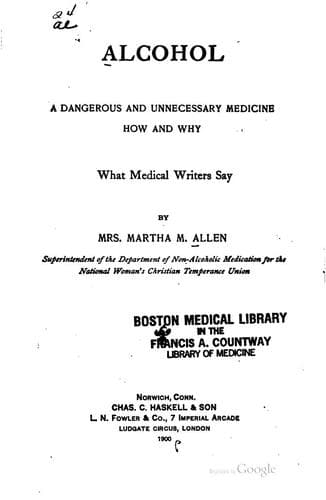
Alcohol: A Dangerous and Unnecessary Medicine, How and Why: What Medical Writers SayAllen, Martha Meir
Science
Alcohol: A Dangerous and Unnecessary Medicine, How and Why: What Medical Writers Say
Allen, Martha Meir
Alcohol -- Physiological effect; Temperance
"In the cases cited, ice-bags, alternated with fomentations,
were used over the abdomen externally, and heat, or hot and
cold, to spine. The extremities were kept warm. From ten to
thirty minims of turpentine, in an ounce of gum acacia or starch
water, increased the efficiency of the enemata, and aided in
expelling the gas and checking hemorrhage.
"The tendency to hypostatic congestion and bed-sores, was
prevented by frequent change of position, and the use of hot and
cold to the spine by fomentations and compresses, or better
still, hot fine spraying, or the alternate hot and cold spray.
In one grave case, spraying was kept up for about twelve hours,
with only short intermissions. The heart was stimulated by heat
applied over it, whenever depression and collapse threatened,
and by hot and cold sponging of the spine."
Dr. Noble said some time ago in the _London Times_:--
"Although it is true that alcohol is an antipyretic, yet its
exhibition neither shortens nor modifies (favorably) the
diseases of which the fever is but a symptom. The paralysis of
the brain which is so frequent a cause of death in typhoid
fever, is more often brought about by alcohol than any other
cause, and more than one woman suffering from puerperal fever
has been done to death by the administration of this substance,
which, not being _convenienter naturae, is contra naturam_."
J. S. Cain, M. D., in an able paper, read at the Nashville Academy of
Medicine, on "Rational Suggestions in the Treatment of Typhoid Fever,"
dissents from the practice, which still obtains largely in the medical
profession, of administering alcoholic liquors, in the belief that they
are "stimulants, conservators of force and even nutrients," and says:--
"After a careful and thoughtful study of this subject, I have
reluctantly, and against firm early convictions, been forced to
the conclusion that these theories with regard to the beneficial
effects of alcohol in disease are wholly fallacious. The only
rational conclusion at which I can arrive is that the agent is
ever, and under all circumstances, a depressor of temperature;
that it arrests the physiological interchange of carbonic acid
gas and oxygen in the tissues, as well as in the air vesicles of
the lungs; that it impedes the elimination of tissue waste, and
causes the accumulation of this refuse in the system; that it is
lethal anaesthetic in all quantities; that it is not stimulant in
the true sense, and never exerts that influence; and that it
supplies no element to the diseased and vitiated system
calculated to antagonize disease, repair waste, or invigorate
lowered vital forces, and therefore for these purposes is not
called for in the rational treatment of typhoid fever."
Public-domain text, read in full here on John Shaqi.
Reviews
Reviews
No reviews yet
Be the first to share your thoughts on this work.
Elsewhere in the archive
Join the Discussion
Join the discussion
Sign in to leave a comment or review.
Sign InorCreate an account