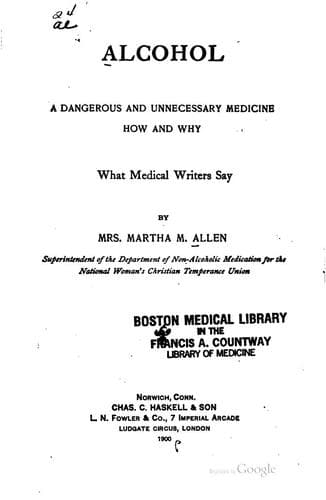
Alcohol: A Dangerous and Unnecessary Medicine, How and Why: What Medical Writers SayAllen, Martha Meir
Science
Alcohol: A Dangerous and Unnecessary Medicine, How and Why: What Medical Writers Say
Allen, Martha Meir
Alcohol -- Physiological effect; Temperance
"The same anaesthetic properties of the alcohol that render the
laboring man less _conscious_ of the cold or heat or weariness,
also render the sick man less conscious of suffering, either
mental or physical, and thereby deceive both him and his
physician by the appearance, temporarily, of more comfort. But
if administered during the progress of fevers or acute general
disease, while it thus quiets the patient's restlessness and
lessens his consciousness of suffering, it also directly
diminishes the vasomotor and excito-motor nerve forces with
slight reduction of temperature, and steadily diminishes both
the tissue metabolism and the excretory products, thereby
favoring the retention in the system of both the specific causes
of disease and the natural excretory materials which should have
been eliminated through the skin, lungs, kidneys and other
glandular organs. Although the immediate effect of the remedy is
thus to give the patient an appearance of more comfort, the
continued dulling or anaesthetic effect on the nervous centres,
the diminished oxygenation of the blood, and the continued
retention of morbitic and excretory products, all serve to
protract the disease, increase molecular degeneration, and add
to the number of fatal results.
"I am well aware that the foregoing views, founded on the
results of numerous and varied experimental researches and
well-known physiological laws, and corroborated by a wide
clinical experience, are in direct conflict with the very
generally accepted doctrine that alcohol is a cardiac tonic,
capable of increasing the force and efficiency of the
circulation, and therefore of great value in the treatment of
the lower grades of general fevers. But there have been many
generally accepted doctrines in the history of medicine that
have been proved fallacious. And the more recent experiments of
Professors Martin, Sidney Ringer, and Sainsbury, Reichert, H. C.
Wood and others, have clearly demonstrated that the presence of
alcohol in the blood as certainly diminishes the sensibility of
the vasomotor and cardiac nerves in proportion to its quantity
until the heart stops, paralyzed, as that two and two make
four.
"After an ample clinical field of observation in both hospital
and private practice for more than fifty years, and a continuous
study of our medical literature, I am prepared to maintain the
position that the ratio of mortality from all the acute general
diseases has increased in direct proportion to the quantity of
alcoholic remedies administered during their treatment. How can
we reasonably expect any other result from the use of an agent
that so directly and uniformly diminishes the cerebral
respiratory, cardiac and metabolic functions of the living human
body?"
Public-domain text, read in full here on John Shaqi.
Reviews
Reviews
No reviews yet
Be the first to share your thoughts on this work.
Elsewhere in the archive
Join the Discussion
Join the discussion
Sign in to leave a comment or review.
Sign InorCreate an account