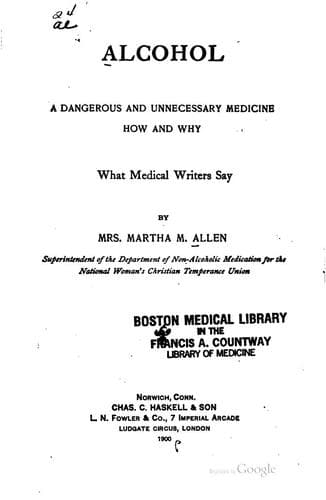
Alcohol: A Dangerous and Unnecessary Medicine, How and Why: What Medical Writers SayAllen, Martha Meir
Science
Alcohol: A Dangerous and Unnecessary Medicine, How and Why: What Medical Writers Say
Allen, Martha Meir
Alcohol -- Physiological effect; Temperance
The _Medical Pioneer_ of January, 1896, contained a very interesting
article by Dr. J. H. Kellogg upon "The Influence of Alcohol upon Urinary
Toxicity, and its Relation to the Medical Use of Alcohol." He gives the
results of many of his own experiments to determine the effects of
alcohol in hindering the elimination of poisonous matter by the kidneys.
The subject of one experiment was a healthy man of 30 years, weighing 66
kilos. For fifty days prior to the experiment he had taken a carefully
regulated diet, and the urotoxic coefficient had remained very nearly
uniform. The urine carefully collected for the first eight hours after
the administration of 8 ounces of brandy diluted with water, showed an
enormous diminution in the urotoxic coefficient, which was, in fact,
scarcely more than half the normal coefficient for the individual in
question. The urine collected for the second period of eight hours
showed an increase of toxicity, and that for the third period of eight
hours showed still further increase of toxicity, the coefficient having
nearly returned to its normal standard.
Of this Dr. Kellogg says:--
"The bearing of this experiment upon the use of alcohol in
pneumonia, typhoid fever, erysipelas, cholera and other
infectious diseases, will be clearly seen. In all the maladies
named, and in nearly all other infectious diseases, which
include the greater number of acute maladies, the symptoms which
give the patient the greatest inconvenience, and those which
have a fatal termination, when such is the result, are directly
attributable to the influence of the toxic substances generated
within the system of the patient as the result of the specific
microbes to which the disease owes its origin. The activity of
the liver in destroying these poisons, and of the kidneys in
eliminating them, are the physiologic processes which stand
between the patient and death. In a very grave case of
infectious disease, without this destructive and eliminative
activity the accumulation of poison within the system would
quickly reach a fatal point. The symptoms of the patient vary
for better or worse in relation to the augmentation or
diminution of the quantity of toxic substances within the body.
Public-domain text, read in full here on John Shaqi.
Reviews
Reviews
No reviews yet
Be the first to share your thoughts on this work.
Elsewhere in the archive
Join the Discussion
Join the discussion
Sign in to leave a comment or review.
Sign InorCreate an account