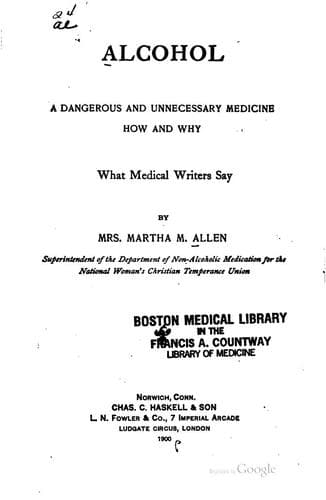
Alcohol: A Dangerous and Unnecessary Medicine, How and Why: What Medical Writers SayAllen, Martha Meir
Science
Alcohol: A Dangerous and Unnecessary Medicine, How and Why: What Medical Writers Say
Allen, Martha Meir
Alcohol -- Physiological effect; Temperance
Among the more recent findings of science in regard to the effects of
alcohol are the action of this drug upon the leucocytes or "guardian
cells" of the body. Leucocytes are defined to be "minute, nucleated,
colorless masses of protoplasm, capable of ameboid movements, found
swimming freely in blood and lymph, in the reticulum of lymphatic
glands, and in bone-marrow and other connective tissue." The white
corpuscles of the blood are leucocytes. "The work of these cells is to
prey upon and take into their substance bacteria and other
micro-organisms within the blood and tissues. This destruction of
bacteria, and other noxious organisms, has the biological name of
phagocytosis."
Dr. Alonzo Brown in _Physician and Surgeon_ says of phagocytosis:--
"Recently a brilliant theory has been projected into the
histological world. It is the principle of phagocytosis. The
beauty of it is so great that we are attracted by it, and its
reasonings have riveted general attention. It is said that
certain cells have the power to absorb and so destroy other
cells. This is phagocytosis. It is said that 'the cells which
are known to possess phagocytocic properties are the leucocytes,
mucous corpuscles, connective tissue cells, endothelia of blood
vessels and lymphatic vessels, alveolar eypithelium of the
lungs, and the cells of the spleen, bone, marrow and lymphatic
glands.' (Senn). This is a very significant array of colloid
matter; and it has been repeatedly affirmed by the highest
authorities that alcohol is poisonous to the colloid element.
"Now, among the most important of the phagocytes just enumerated
are the leucocytes. They embrace and enfold the pathogenic germs
with which they come in contact by what is known as an ameboid
force. They enclose, disintegrate and absorb the enemy. It is
well known that the moment the leucocytes are submitted to an
alcoholic solution, their ameboid movements cease, and their
function is arrested. It is plain that their phagocytocic power
is immediately destroyed. It is possible, also, that the fixed
tissue-cells are likewise impaired or killed by alcoholic
imbibition. How deleterious, and even deadly, must the internal
administration of alcoholic liquors then be in the treatment of
diphtheria, and of other diseases having a germinal origin? It
therefore follows, to my mind, that all the diseases which are
the result of germinal infection, are most badly treated when
alcohol is used in their therapy.
Public-domain text, read in full here on John Shaqi.
Reviews
Reviews
No reviews yet
Be the first to share your thoughts on this work.
Elsewhere in the archive
Join the Discussion
Join the discussion
Sign in to leave a comment or review.
Sign InorCreate an account