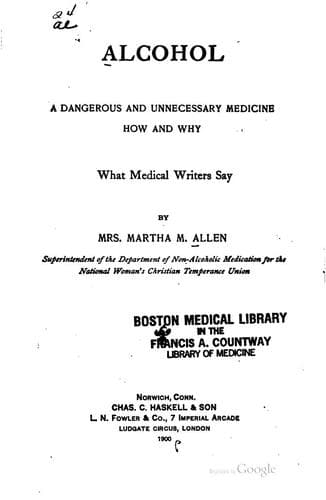
Alcohol: A Dangerous and Unnecessary Medicine, How and Why: What Medical Writers SayAllen, Martha Meir
Science
Alcohol: A Dangerous and Unnecessary Medicine, How and Why: What Medical Writers Say
Allen, Martha Meir
Alcohol -- Physiological effect; Temperance
"In a recent number of the _British Medical Journal_, Dr. Lauder
Brunton, the eminent English physiologist and neurologist, in
mentioning the fact that death from chloroform anaesthesia rarely
occurs in India, but is not infrequent in England, attributed
the fact to the meat-eating habits of the English people, the
natives of India being almost strictly vegetarian in diet,
partly from force of circumstances doubtless, but largely also,
no doubt, as the result of their religious belief, the larger
proportion of the population being more or less strict adherents
to the doctrines of Buddha, which strictly prohibit the use of
flesh foods.
"The theory advanced by Dr. Lauder Brunton in relation to death
from chloroform poisoning, is that the patient does not die
directly from the influence of chloroform upon the nerve
centres, but that death is due to the influence of chloroform
upon the kidneys, whereby the elimination of the ptomaines and
leucomaines naturally produced within the body, ceases, their
destruction by the liver also ceasing, so that the system is
suddenly overwhelmed by a great quantity of poison, and succumbs
to its influence, its power of resistance being lessened by the
inhalation of the chloroform.
"The affinity between alcohol and chloroform is very great. Both
are anaesthetics. Both chloroform and alcohol are simply
different compounds of the same radical, and the results of our
experiment certainly suggest the same thought as that expressed
by Dr. Brunton. How absurd, then, is the administration of
alcohol in conditions in which the highest degree of kidney
activity is required for the elimination of toxic agents!
"In a certain proportion of chronic cases there is a tendency to
tissue degeneration. Modern investigations have given good
ground for the belief that these degenerations are the result of
the influence of ptomaines, leucomaines and other poisons
produced within the body, upon the tissues. It is well known
that many of these toxic agents, even in very small quantity
give rise to degenerations of the kidney. It is this fact which
explains the occurrence of nephritis in connection with
diphtheria, scarlet fever and other infectious maladies. Dana
has called attention to the probable role played by ptomaines
produced in the alimentary canal in the development of organic
disease of the central nervous system.
"It is thus apparent that the integrity of the renal functions
is a matter of as great importance in chronic as in acute
disease, hence any agent which diminishes the efficiency of
these organs in ridding the system of poisons, either those
normally and regularly produced, or those of an accidental or
unusual character, must be pernicious and dangerous in use."
Public-domain text, read in full here on John Shaqi.
Reviews
Reviews
No reviews yet
Be the first to share your thoughts on this work.
Elsewhere in the archive
Join the Discussion
Join the discussion
Sign in to leave a comment or review.
Sign InorCreate an account