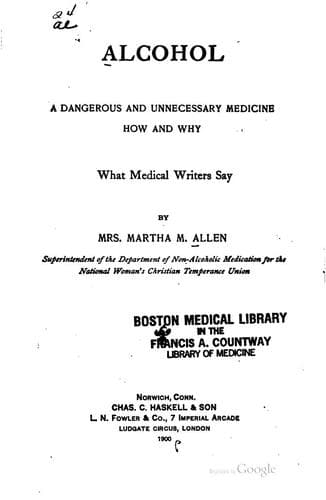
Alcohol: A Dangerous and Unnecessary Medicine, How and Why: What Medical Writers SayAllen, Martha Meir
Science
Alcohol: A Dangerous and Unnecessary Medicine, How and Why: What Medical Writers Say
Allen, Martha Meir
Alcohol -- Physiological effect; Temperance
"Dr. Broadbent's introductory address at the opening of the
session at Owen's College, Manchester, deserves more attention
than most of these formal deliveries. He dwelt on the
intellectual interest which attaches to the study of medical
science, and illustrated it, among other ways, by the interest
excited by recent observations on the action of bacilli and the
combat which goes on between these invading hosts and the
guardian cells or leucocytes of the living body. Inflammation
surrounding a wound is regarded as caused by the influx and
multiplication of leucocytes to engulf and destroy septic
bacilli which have gained entrance from the air, a 'local war'
of defence. The issue of this pitched battle will depend on the
relative number and activity of the respective hosts.
Inflammation round a poisoned wound is an evidence of vital
power and a means of protecting the system at large from
invasion and devastation. If this first line of defence is
broken through, the bacilli pass through the lymphatic spaces
and ducts to the glands, and another battle ensues which
produces glandular swelling and inflammation and possibly
abscess. This second line of defence may be insufficient and
then we get general septicaemia. It is now well proven that the
injury is done, not by the bacilli themselves but by the toxines
which they secrete or excrete. Dr. Broadbent very properly
points out that the action of the bacilli of fever in the body
is strictly comparable to the action of yeast in a fermentable
liquid. The yeast cells grow and multiply at the expense of the
sugar, in destroying which they produce alcohol, carbonic
dioxide and other substances. When the alcohol amounts to some
17 per cent. of the liquid the process is stopped by the
poisonous action of the alcohol on the yeast cells. In just the
same way the toxines produced by the bacilli at length stop
their further multiplication and put an end to the disease.
Alcohol is in fact, the toxine produced by yeast, and, like many
other toxines, it is not only poisonous to cells which produce
it, but to any animal into whose veins it may happen to get.
Public-domain text, read in full here on John Shaqi.
Reviews
Reviews
No reviews yet
Be the first to share your thoughts on this work.
Elsewhere in the archive
Join the Discussion
Join the discussion
Sign in to leave a comment or review.
Sign InorCreate an account