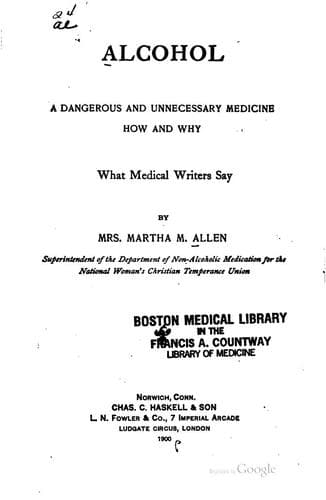
Alcohol: A Dangerous and Unnecessary Medicine, How and Why: What Medical Writers SayAllen, Martha Meir
Science
Alcohol: A Dangerous and Unnecessary Medicine, How and Why: What Medical Writers Say
Allen, Martha Meir
Alcohol -- Physiological effect; Temperance
"There can be little doubt that the state of immunity which one
attack of certain fevers confers against future attacks depends
partly upon what is called the phagocytic action of leucocytes.
These have been actually observed to draw into their interior
and destroy bacilli which would otherwise have multiplied and
produced their special effects. There can be little doubt,
either, that we are continually taking into our systems bacilli
of all sorts, and that, again, disease is averted by the
activity of the germ-devouring leucocytes. Dr. Broadbent
describes an experiment which proves that power of resisting
disease is largely dependent on the activity of these cells. A
rabbit, having had a certain quantity of bacilli injected under
its skin, suffers from inflammation at the spot, and perhaps
abscess, but recovers. At the same time, another rabbit is
treated in precisely the same way, but, simultaneously, a dose
of chloral is injected into another part of the body. The
chloral, circulating in the blood, is known to paralyze
leucocytes, and, as a result of this, they do not collect and
wage war on the bacilli injected under the skin; there is very
little local reaction, the bacilli get free course into the
lymph and blood, and the animal dies. But, in the words of Dr.
Broadbent, 'alcohol in excess has a similar action on the
leucocytes, and this, as well as the deteriorating influence of
chronic alcoholism on the tissues, predisposes to septic
infection. A single debauch, therefore, may open the door to
fever or erysipelas.' A similar experiment of Doyen confirms
this. He found that guinea pigs can be killed by the cholera
microbe, when introduced by the mouth, if a dose of alcohol has
been previously administered. It has been the general testimony
of observers in cholera epidemics that those addicted to much
alcohol are far more liable to fatal attacks. But while large
doses of alcohol are, of course, more obviously injurious, it
would be absurd to imagine that lesser quantities are entirely
without influence in the same direction. It has, indeed, been
shown by Dr. Ridge, that even infinitesimal quantities of
alcohol, such as one part in 5,000, cause a more rapid
multiplication of the _bacillus subtilis_ and other bacilli of
decomposition, while, by the same quantities, the growth of both
animal and vegetable protoplasm is retarded. Hence there can be
no longer any question that alcohol renders the body more liable
to conquest by invading microbes, less able to resist and
destroy them. Alcohol, a toxine injurious to living cells, is
destroyed or removed from the body as fast as nature can effect
it, but while it remains, and while able to affect the cells at
all, its action is detrimental to healthy growth and healthy
Public-domain text, read in full here on John Shaqi.
Reviews
Reviews
No reviews yet
Be the first to share your thoughts on this work.
Elsewhere in the archive
Join the Discussion
Join the discussion
Sign in to leave a comment or review.
Sign InorCreate an account