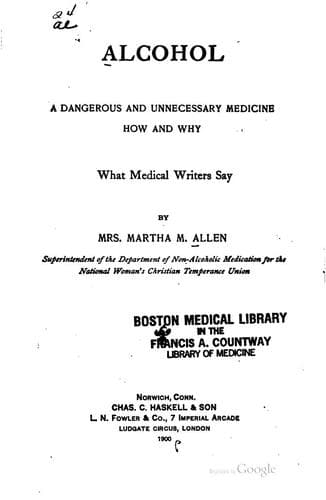
Alcohol: A Dangerous and Unnecessary Medicine, How and Why: What Medical Writers SayAllen, Martha Meir
Science
Alcohol: A Dangerous and Unnecessary Medicine, How and Why: What Medical Writers Say
Allen, Martha Meir
Alcohol -- Physiological effect; Temperance
"It is pointed out, as most of us have from time to time had the
opportunity of observing, that, taking pneumonia as an example
of this class of disease, there can be no doubt that the
alcoholic patient has not merely an appreciably smaller chance
for recovery, but an apparently slight attack becomes one in
which the chances of recovery come to be against the patient
rather than in his favor. I well remember when I was House
Physician in the Royal Infirmary at Edinburgh that Dr. Muirhead,
who almost invariably treated his pneumonic patients without
alcohol, used to say that an ordinary case of acute pneumonia
should always recover under careful treatment, but that cases of
pneumonia in 'alcoholics' were always most anxious cases and in
every way unsatisfactory. (Slides were shown on screen to
illustrate the changes taking place in pneumonia, the conditions
of leucocytosis, and the very important part which leucocytes
play in the process of 'clearing up' during the course of the
patient's recovery). Dr. Delearde in an admirable summary gives
the principal features of pneumonia in alcoholics. He describes
it as running a comparatively prolonged course, as being often
accompanied by a violent delirium, following which is a period
of prostration or of coma; even in those who recover, abscesses
frequently occur in the liver, or in other organs. He also
points out that there may be a similar chain of events in other
infective conditions such as erysipelas and typhoid fever, but
as he insists that, until Abbott's experiments on the
streptococcus,[A] staphylococcus[A] and bacterium coli,[A] in
alcoholized and non-alcoholized animals, little attempt has
been made to indicate the mechanism, or, at any rate, the
process by which alcoholized individuals are rendered more
susceptible to the invasion and action of micro-organisms.
[Footnote A: Microbes or bacteria of different kinds.]
"As we have already seen, Abbott's experiments prove beyond
doubt that attenuated disease-producing organisms, which in
healthy animals do not kill immediately, bring about a fatal
result when the animal has previously been treated with alcohol.
In order to determine which was the most important factor in the
destruction or weakening of the resisting agents in the body,
Dr. Delearde conceived the idea of experimenting with those
diseases in which it has been found possible to produce,
artificially, as it were, and under controlled conditions, an
immunity or insusceptibility in healthy animals. He carried out
a series of experiments on rabbits, immunizing against and
infecting with the virus of hydrophobia, tetanus and anthrax.[B]
To these rabbits he first administered a quantity of alcohol,
from 6 to 8 c.c. at first, and gradually rises to 10 c.c. doses
per diem.
Public-domain text, read in full here on John Shaqi.
Reviews
Reviews
No reviews yet
Be the first to share your thoughts on this work.
Elsewhere in the archive
Join the Discussion
Join the discussion
Sign in to leave a comment or review.
Sign InorCreate an account