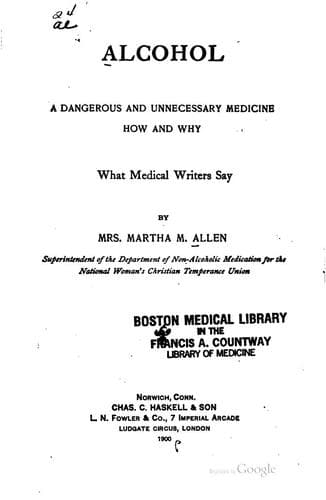
Alcohol: A Dangerous and Unnecessary Medicine, How and Why: What Medical Writers SayAllen, Martha Meir
Science
Alcohol: A Dangerous and Unnecessary Medicine, How and Why: What Medical Writers Say
Allen, Martha Meir
Alcohol -- Physiological effect; Temperance
That the "guardian cells" of the body play a part in a considerable
number of diseases was illustrated by Dr. Woodhead by drawings and
photographs, shown on the lantern screen. The photographs included cells
containing anthrax, typhoid and tubercle bacilli, the spirilla of
relapsing fever, specimens from cases of anthrax. Specimens were shown
in which the cells were actually ingesting and digesting the specific
micro-organisms. In a case of typhoid, showing large masses of typhoid
bacilli in one of Peyer's patches, there were seen certain of the cells
which contained the typhoid bacilli, some of them undergoing
degenerative changes, and showing unequal standing.
Of the researches made by Dr. Abbott referred to in the foregoing
lecture Dr. N. S. Davis says:--
"Thus we have another and direct positive demonstration of the
fact that the presence of alcohol in living bodies not only
impairs all the physiological processes, but also impairs their
vital resistance to the effects of all other poisons. It was
hardly necessary, however, to trouble the rabbits to obtain
proof of this; for such evidence may be found in abundance by
examining the vital statistics of every civilized country. The
late Frank H. Hamilton, in his valuable work on military
hygiene, gives an interesting account of an experiment executed,
not on a few rabbits, but on whole regiments of human beings,
who were being exposed to the inhibition, not of the
streptococcus pyogenes, but to the infections of malarial and
typho-malaria fever. And, as many were attacked with sickness,
it was thought by some of those in authority that if the
soldiers were given a specified ration of alcoholic liquor two
or three times a day, it might enable them to resist the morbid
influences to which they were exposed. The proposed ration was
accordingly ordered, and Dr. Hamilton informs us that the
soldiers taking the liquor ration succumbed to the morbific
influences surrounding them so much more rapidly than before,
that in less than sixty days the order was countermanded, and
the liquor ration stopped. And that eminent surgeon and
sanitarian added, with peculiar emphasis, that he wished never
to see the same experiment tried again."
Dr. J. J. Ridge, of London, has learned through his experiments that
alcohol not only hinders the leucocytes in their war upon disease germs,
but also tends to the multiplication of germs. Of this he says:--
"The antagonism of alcohol to the fundamental functions of life
is further exhibited by its action on the cellular elements of
living tissues and the free cells or leucocytes of the blood.
Dr. Lionel Beale long ago pointed out how it affected the
protoplasm of cells, and diminished the movements of amoebae,
to which leucocytes are apparently analogous.
Public-domain text, read in full here on John Shaqi.
Reviews
Reviews
No reviews yet
Be the first to share your thoughts on this work.
Elsewhere in the archive
Join the Discussion
Join the discussion
Sign in to leave a comment or review.
Sign InorCreate an account