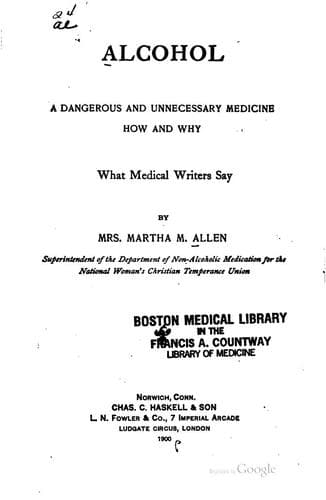
Alcohol: A Dangerous and Unnecessary Medicine, How and Why: What Medical Writers SayAllen, Martha Meir
Science
Alcohol: A Dangerous and Unnecessary Medicine, How and Why: What Medical Writers Say
Allen, Martha Meir
Alcohol -- Physiological effect; Temperance
"From all this Dr. Delearde draws the practical conclusion that
patients who have been bitten by a mad dog should as far as
possible abstain from the use of alcohol not only during the
process of treatment, but also for some time afterwards, even
for a period of eight months, during which period, apparently,
increase of immunity may be going on. Beyond this he maintains
that doctors often commit a grave error in administering strong
doses of alcohol to patients suffering from certain infectious
diseases such as pneumonia, or from certain intoxications such
as those produced by snake-bite, during which an increase in the
number of leucocytes appear to be a necessary part of any
process that leads to the cure of the patient. Finally, he
points out how necessary it is that we should respect the
integrity of the leucocytes in the presence of microbic
infections or intoxications. We may accept these statements all
the more readily as Dr. Delearde states that 'although we must
recognize that small doses of dilute alcoholic beverages are
indicated in certain cases where it is necessary to stimulate
the nervous system, one must guard oneself against an abuse
which may certainly be prejudicial to the putting into operation
of the mechanism of defence against the organisms of disease.'
"In so far as these conclusions rest on a series of exact
experiments we are justified in accepting them as being a most
valuable contribution to the question; where there is no
experimental basis, we must exercise our own judgment. To show
the very strong impression that exists that there is some
connection between severe cases of pneumonia and alcohol I may
mention that the other day I heard a gentleman (not a medical
man) say, 'It is well known that most men (of a certain
profession) die from alcoholism.' When asked to explain he said,
'They all die from cirrhosis or pneumonia, and if those
conditions are not due to alcoholism, what is?'
"There can be no doubt that in addition to its specific action,
alcohol has a general action--the mal-nutrition, which is
usually associated with the use of alcohol, especially as a
result of its action on the mucous membranes of the stomach,
etc."
Public-domain text, read in full here on John Shaqi.
Reviews
Reviews
No reviews yet
Be the first to share your thoughts on this work.
Elsewhere in the archive
Join the Discussion
Join the discussion
Sign in to leave a comment or review.
Sign InorCreate an account