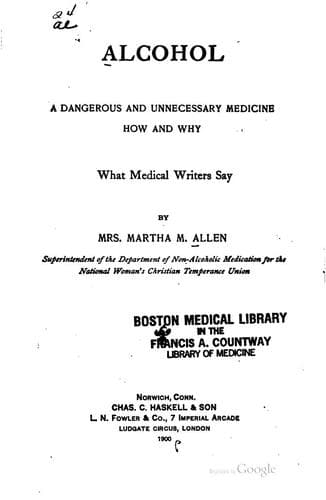
Alcohol: A Dangerous and Unnecessary Medicine, How and Why: What Medical Writers SayAllen, Martha Meir
Science
Alcohol: A Dangerous and Unnecessary Medicine, How and Why: What Medical Writers Say
Allen, Martha Meir
Alcohol -- Physiological effect; Temperance
"But some persons say they are afraid to abandon the use of
alcohol because they have been in the habit of taking it for a
long period. This fear is entirely groundless. The alcohol will
be missed for a time, just as a person who has been using
crutches would miss them if thrown away; but they will do better
without both after a little while. There is no kind of
constitution which renders a person unable to do without
alcohol. The prisoners in all our jails have to leave off their
drink at once, and altogether, on entering there, and no harm
ever ensues in consequence. But some say that this is because
their diet is so carefully arranged, and the hygienic condition
of the prison so perfect. Quite so. This shows us clearly that
when total abstainers become ill outside the prison, their
illness is to be attributed to some error in diet or hygiene, or
to some accidental circumstance. It is absurd to think that the
infraction of one law of health can be nullified by breaking
another; that if you eat too much, or too fast, or too often, or
what is not good for you, you can escape the consequences by
injuring yourself with alcohol."
Dr. N. S. Davis was for many years openly sneered at by many of his
professional brethren as "a cold-water fanatic." Since his views are now
being rapidly adopted by progressive medical men all over the civilized
world, it may be that soon those physicians who cling to alcohol will
deserve the soubriquet of "alcohol fanatics." Dr. Davis said:--
"If I am asked why the profession continues to prescribe these
drinks, I answer; simply from the force of habit and traditional
education, coupled with a reluctance to risk the experiment of
omitting them while the general popular notions sanction their
use. Nothing is easier than self-deception in this matter. A
patient is suddenly taken with syncope, or nervous weakness,
from which abundant experience has shown that a speedy recovery
would take place by simple rest and fresh air. But in the alarm
of friends something must be done. A little wine or brandy is
given, and as it is not sufficient to positively prevent, the
patient in due time revives just as would have been the case if
neither wine nor brandy had been used.
Public-domain text, read in full here on John Shaqi.
Reviews
Reviews
No reviews yet
Be the first to share your thoughts on this work.
Elsewhere in the archive
Join the Discussion
Join the discussion
Sign in to leave a comment or review.
Sign InorCreate an account