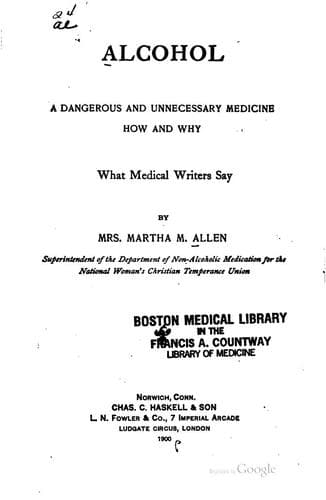
Alcohol: A Dangerous and Unnecessary Medicine, How and Why: What Medical Writers SayAllen, Martha Meir
Science
Alcohol: A Dangerous and Unnecessary Medicine, How and Why: What Medical Writers Say
Allen, Martha Meir
Alcohol -- Physiological effect; Temperance
"Of course both doctor and friends will regard the so-called
stimulant as the cause of the recovery. So, too, when patients
are getting weak, in the advanced stage of fever, or some other
self-limited disease, an abundance of nourishment is regularly
administered, in the greater part of which is mixed some kind of
alcoholic drink. The latter will always occupy the chief
attention, and if, after a severe run, the fever, or disease,
finally disappears, it will be said that the patient was
sustained or 'kept alive' for over two or three weeks, as the
case may be, 'solely by the stimulants,' when, in fact, if the
same nourishment and care had been given without a drop of
alcohol, he would have convalesced sooner, and more perfectly,
as I have seen demonstrated a thousand times in my experience."
Dr. Casgrau, of Dublin, says that physicians who make personal use of
alcohol are not able to give an unbiased opinion about its action, as
one of its most marked effects is that of a narcotic to the mental
powers; such physicians are not so acute to observe the action of this,
or any drug.
Sir B. W. Richardson, M. D., in an address upon the reasons why
physicians still prescribe alcoholics, says that the magnetism of public
opinion has great weight with professional men.
"All professions are under that subtle influence. All
professions whatever their duties, whatever their learning may
be, are sensitive and obedient to that influence. In their pride
they think they lead public opinion; it is a mistake, they
always follow it on every question in which the people, at
large, have a voice. They can assist in influencing the public
voice, and sometimes, to quote the words of Abbe Purcelle,
spoken in the dawn of the great French Revolution, they may
prove that 'respect for sovereign power sometimes consists in
transgressing its orders,' but as a general rule not merely the
orders but the inclinations are obeyed. We have to wait on, and
for, public opinion, and in nothing so much as on the subject of
alcohol. The use of alcoholic beverages rests not on argument
but on habit, custom. To those whom it affects personally it is
an absolute monarch. It makes its own empire. By the very action
which it has upon the body of those who receive it into
themselves it rules and governs. The joke of the inebriate man
that when he had taken his potation he was quite another man and
that then he felt it his duty to treat that other man, is
literally true, a terse and faithful expression of a natural
fact. The man or woman born and bred under the influence of
alcohol is of the race of alcohol, and as distinct a person as
any racial peculiarity can supply. The reason, the judgment, the
temper, the senses are attuned by it. It is loved by its lovers
like life. The grape to them is no longer a luscious fruit; it
Public-domain text, read in full here on John Shaqi.
Reviews
Reviews
No reviews yet
Be the first to share your thoughts on this work.
Elsewhere in the archive
Join the Discussion
Join the discussion
Sign in to leave a comment or review.
Sign InorCreate an account