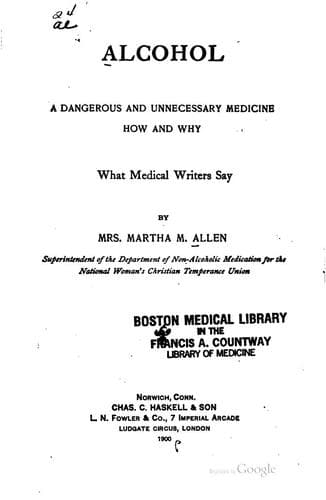
Alcohol: A Dangerous and Unnecessary Medicine, How and Why: What Medical Writers SayAllen, Martha Meir
Science
Alcohol: A Dangerous and Unnecessary Medicine, How and Why: What Medical Writers Say
Allen, Martha Meir
Alcohol -- Physiological effect; Temperance
"It was soon ascertained that antipyrin, antifebrin, phenacetin
and other analogous products, if given in sufficient doses,
would reduce the heat, and allay the pains with great certainty
and promptness, not only in continued fevers, but also in
rheumatism, influenza, or la grippe, etc.; and thus their use
soon became popular with both the profession and the public. No
one, however, undertook to first ascertain by strictly
scientific appliances the actual pathological processes causing
the pyrexia in each form of disease, or even to determine
whether in any given case the increased heat was the result of
increased heat production, or diminished heat dissipation.
Neither were any of the remedies subjected to such experimental
investigation as to determine their influence on the elements of
the blood, the internal distribution of oxygen, the metabolism
of the tissues, or on the activity of the eliminations.
Consequently their exhibition was wholly empirical, and the one
that subdued the pyrexia most promptly was given the preference.
Yet we all know that the pyrexia invariably returned as soon as
the effects of each dose were exhausted, and in a few years the
results showed that while the antipyretics served to keep down
the pyrexia, and give each case the appearance of doing well,
the average duration of the cases, and their mortality, were
both increased.
"Step by step experimental therapeutic investigations have
proved that the whole class of coal-tar antipyretics reduce
animal heat by impairing the capacity of the hemoglobin and
corpuscular elements of the blood to receive and distribute free
oxygen, and thereby reduce temperature by diminishing heat
production, nerve sensibility and tissue metabolism. Therefore,
while each dose temporarily reduces the fever, it retards the
most important physiological processes on which the living
system depends for resisting the effects of toxic agents;
namely, oxidation and elimination. This not only encourages the
retention of toxic agents and natural excretory materials by
which specific fevers are protracted, but it greatly increases
the number of cases of pneumonia that complicate the epidemic
influenza, or la grippe, as it has occurred since 1888-89.
"The bad work that people make in dosing themselves with patent
medicines, without a physician's prescription is not
unfrequently punctuated with a sudden death from overdosing with
antipyrin, sulphonal, or some other coal-tar preparation."
Dr. C. H. Shepard, Brooklyn, N. Y., says:--
Public-domain text, read in full here on John Shaqi.
Reviews
Reviews
No reviews yet
Be the first to share your thoughts on this work.
Elsewhere in the archive
Join the Discussion
Join the discussion
Sign in to leave a comment or review.
Sign InorCreate an account