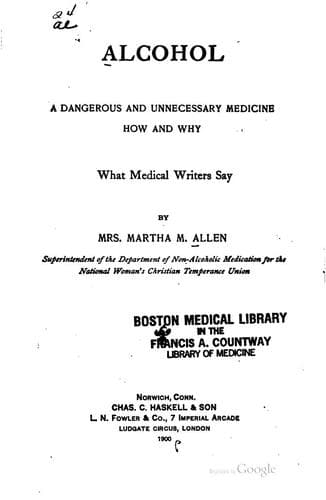
Alcohol: A Dangerous and Unnecessary Medicine, How and Why: What Medical Writers SayAllen, Martha Meir
Science
Alcohol: A Dangerous and Unnecessary Medicine, How and Why: What Medical Writers Say
Allen, Martha Meir
Alcohol -- Physiological effect; Temperance
"The druggist who told me about the thing says that as ginger
essence contains about one hundred per cent. alcohol, and whisky
less than fifty per cent., the former is therefore twice as
intoxicating. In fact, this is the reason why it is used by
hardened old topers whose stomachs are no longer capable of
intoxicating stimulation from whisky. They need the more
powerful agency of the pure alcohol in the ginger extract. He
told me that he had two regular customers, one a woman, who had
ginger on several occasions for stomachic pains. The relief it
afforded her was so grateful that she took it upon any
recurrence of her trouble. She found, too, that the slight
exhilaration of the alcohol banished mental depression. In this
way she got to using it regularly, and finally to such excess
that she was often grossly intoxicated. Large doses produce a
quiet stupor; additional doses induce a profound lethargic
slumber, which lasts in some cases for twenty-four hours. His
other customer was a peddler, who came at a certain hour every
morning, bought a four-ounce bottle and drank its contents by
noon. The man craved the stuff so ardently that he was unable to
go about his business until he set the machinery of his stomach
in operation, and started the circulation of the blood by means
of the fiery draught. He says that the habit is well known to
the drug trade."
"The morphia habit, the cocaine habit, the chloral habit, and
other poison habits which are prevalent in this and other
countries, are only different manifestations of a wide-spread
and apparently increasing love for drugs which benumb or excite
the nerves, which seems to characterize our modern civilization.
Indeed, there appears to be, at the present time, almost a mania
for the discovery of some new nerve-tickle, or some novel means
of fuddling the senses. It is indeed high time that the medical
profession raised, with one accord, its voice in solemn protest
against the use of all nerve-obtunding and felicity-producing
drugs, which are all, without exception, toxic agents, working
mischief and only mischief in the human body."--DR. J. H.
KELLOGG.
Much discussion upon careless drug-taking has resulted from remarks made
recently in London by Sir Frederick Treves, the King's surgeon, at the
opening of a hospital. He said that the time is fast approaching when
physicians will give very little medicine, but will instead teach the
people right methods of living so that sickness may be avoided.
Public-domain text, read in full here on John Shaqi.
Reviews
Reviews
No reviews yet
Be the first to share your thoughts on this work.
Elsewhere in the archive
Join the Discussion
Join the discussion
Sign in to leave a comment or review.
Sign InorCreate an account