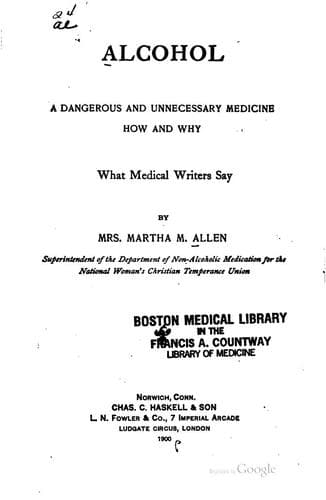
Alcohol: A Dangerous and Unnecessary Medicine, How and Why: What Medical Writers SayAllen, Martha Meir
Science
Alcohol: A Dangerous and Unnecessary Medicine, How and Why: What Medical Writers Say
Allen, Martha Meir
Alcohol -- Physiological effect; Temperance
Although there are some physicians who appear to enjoy the old routine
of giving heroic doses of ill-tasting liquids, there are others who
agree with Sir Frederick, and admit that they would often be glad to
give no medicine if their patients would be satisfied without it. But
the great mass of people are unwilling to take a physician's advice as
to proper clothing, suitable diet, and regular habits of living. They do
not seek his advice upon those points; what they want is a drug that
will benumb uneasy sensations while they live as they please.
Not long ago a business man of intelligence was heard to complain
because he had tried several physicians and all had failed to cure his
sciatica. He said they all told him he must live differently; several
said he must quit smoking and lay aside wine and beer or he could not be
cured. With scorn he said, "What are physicians good for if they don't
know a drug that will cure as simple a thing as rheumatism?" He could
not and would not believe that rheumatism might be the result of his
wrong habits.
Akin to him in thought is a woman, much above the average in
intelligence, who a few months ago had an operation performed upon her
stomach. The stomach was enlarged so that the food did not pass through
the pylorus, the opening into the intestines. The operation consisted in
making a new opening and connecting it with an intestine. This bright
woman now complains that the operation was not a success, because she
still has times of great distress with indigestion. Upon being asked
what she eats, she laughed and said, "Everything, peanuts, mince-pie,
sauer-kraut, frankforts; whatever is going. I have a vigorous appetite,
and keep peanuts and figs in my room, for I often have to eat in the
night."
Until multitudes of people like that business man, and that bright
woman, are educated in matters of health, it will not be easy for
physicians to bring Sir Frederick's prediction to fulfilment.
The popular supposition is that drugs _cure_ disease, and all that the
medical adviser is for is to choose the drug that will produce the
desired effect with the greatest speed. Consequently the physician is in
many cases driven to prescribe drugs that simply allay pain without
removing the cause of the pain. He cannot remove the cause without the
patient's co-operation, and as that would require the abandonment of
wrong habits few are willing to accept health at such a price. What man
will abandon beer to escape rheumatism, or smoking to save his eyesight
if he has weakness there? Or, what woman will cease tea-drinking if she
has neuralgia?
The _Journal of the American Medical Association_ for November 16, 1907,
contained an editorial article in which, after reference to drugs
necessary in the practice of a physician or surgeon, this is said:--
Public-domain text, read in full here on John Shaqi.
Reviews
Reviews
No reviews yet
Be the first to share your thoughts on this work.
Elsewhere in the archive
Join the Discussion
Join the discussion
Sign in to leave a comment or review.
Sign InorCreate an account